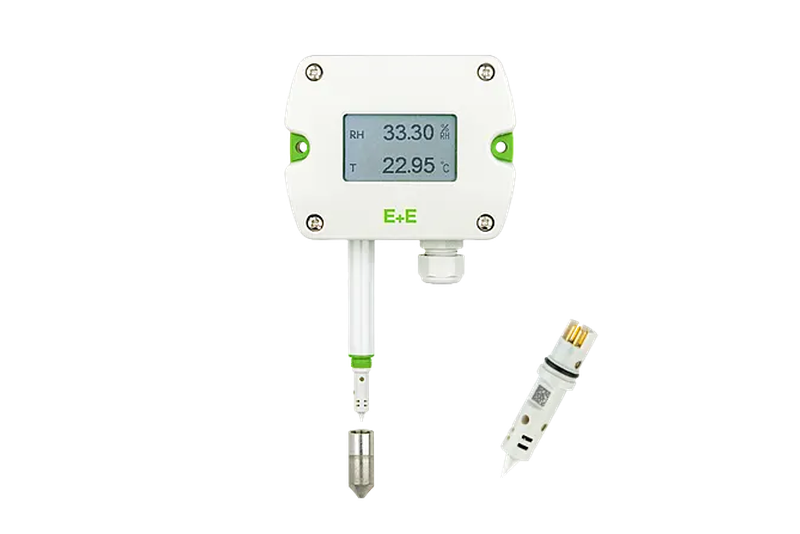
How chemical contamination affects sensor accuracy, reliability and service life – and how advanced sensor protection can help.
Accurate humidity and moisture measurement is essential in many industrial processes, but what happens when sensors are exposed to chemicals, cleaning agents, oil degradation products or other contaminants?
Even small amounts of chemical contamination can affect sensitive measurement elements, leading to sensor drift, unreliable readings and increased maintenance requirements. In demanding environments, this can compromise process control, product quality and equipment reliability.
To address these challenges, E+E Elektronik has introduced ChemShield, a protective barrier technology designed to improve the long-term stability of selected industrial humidity and moisture in oil sensors.
Why Does Chemical Contamination Affect Humidity Sensors?
Many industrial humidity sensors use a sensitive polymer layer that absorbs and releases water molecules as the surrounding humidity changes. Changes in the electrical properties of this layer are used to determine relative humidity.
However, exposure to chemical vapours, solvents and process contaminants can interfere with this measurement principle.
Depending on the substances involved, contamination may alter the sensing element’s response, affect its ability to absorb moisture or damage sensitive electrical connections.
Over time, these effects can cause:
- Measurement drift: Gradual changes in sensor readings, even when actual humidity remains stable.
- Reduced measurement reliability: Incorrect humidity or moisture values affecting process control.
- Slower response: Contamination interfering with the sensor’s ability to respond to changing conditions.
- Increased maintenance: More frequent calibration checks, cleaning or sensor replacement.
- Reduced service life: Chemical attack or persistent contamination potentially causing premature sensor failure.
The consequences extend beyond the sensor itself. Incorrect humidity measurements can affect drying processes, environmental control, manufacturing consistency and equipment protection.
What Is ChemShield and How Does It Work?
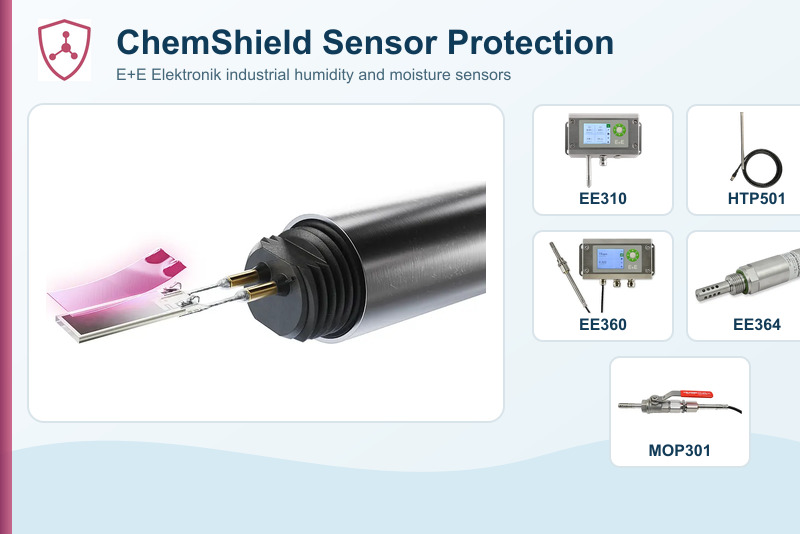
ChemShield is a specially developed protective barrier from E+E Elektronik that reduces the influence of chemical contamination on sensitive sensor components.
The coating is applied to defined areas, including the sensing element and solder joints, helping protect them against harmful chemical influences.
Unlike conventional protective filters that primarily address particulate contamination, ChemShield provides additional protection at the sensor level.
Its purpose is to maintain stable measurement performance in applications where chemical exposure could otherwise cause drift or deterioration.
ChemShield does not eliminate the need for calibration or make sensors immune to every chemical. Instead, it provides an additional level of protection that can improve reliability and reduce the risk of contamination-related measurement problems.
Where Is ChemShield Particularly Beneficial?
Chemical contamination is not limited to chemical manufacturing plants. Many industrial processes expose sensors to substances capable of affecting measurement performance.
1. Pharmaceutical manufacturing and cleanrooms
Cleaning and sterilisation procedures can introduce chemical vapours into controlled environments. Reliable humidity monitoring is essential for maintaining specified environmental conditions and consistent manufacturing processes.
ChemShield can provide additional protection in selected applications where conventional humidity sensors may be affected by repeated chemical exposure.
2. Environmental and climatic test chambers
Test chambers may expose humidity sensors to vapours released from plastics, adhesives, coatings and other materials undergoing testing.
These substances can accumulate or repeatedly contact the sensing element, potentially causing measurement drift and affecting test accuracy.
3. Biofilters and biological treatment processes
Biofilters and related treatment processes can expose humidity sensors to complex mixtures of moisture, gases and chemical contaminants.
Additional protection can help maintain measurement stability where sensor surfaces are exposed to challenging process atmospheres.
4. Fertiliser production and agricultural processing
Chemical vapours and process residues associated with fertiliser production and handling can create demanding conditions for industrial humidity sensors.
Selecting appropriate sensor protection can help reduce contamination-related measurement problems.
5. Industrial drying and fermentation
Drying and fermentation processes can involve changing process atmospheres and the release of volatile substances.
Where these substances interfere with humidity sensing, ChemShield can provide an additional barrier against chemical exposure.
6. Hydraulic, lubricating and turbine oil monitoring
Moisture contamination in industrial oils can contribute to corrosion, reduced lubrication performance and equipment deterioration.
However, the oils themselves can also challenge the measurement sensor. Ageing, oxidation and chemical degradation may produce substances that affect sensitive sensor elements.
ChemShield helps protect compatible moisture in oil sensors from these influences, supporting reliable monitoring in demanding oil systems.
What Happens Without Suitable Sensor Protection?
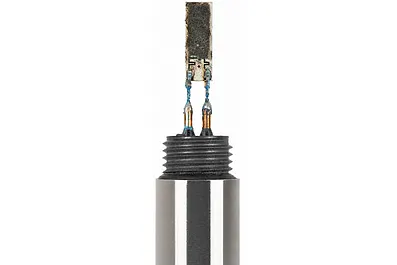
In relatively clean environments, conventional humidity sensors may provide reliable measurements over extended periods.
However, in chemically demanding processes, inadequate protection can increase the risk of gradual sensor deterioration.
For example, an industrial drying process relying on inaccurate humidity measurements could operate outside its intended conditions, affecting drying efficiency or product quality.
Similarly, unreliable moisture measurements in hydraulic or lubricating oils could delay the identification of potentially harmful water contamination.
These risks may lead to more frequent verification, unplanned maintenance or premature sensor replacement.
Selecting a sensor with protection matched to the application can therefore be important for both measurement reliability and overall operating costs.
ChemShield, SensShield and LeadsShield: Different Levels of Protection
E+E Elektronik has developed several complementary technologies to protect sensitive sensor components.
| Technology | Main function |
|---|---|
| ChemShield | Provides a protective barrier against chemical contamination affecting the sensing element and other defined areas. |
| SensShield | Protects sensing elements and electrical connections against dust, dirt, oily deposits, salts, humidity and other environmental influences. |
| LeadsShield | Protects sensitive electrical connections and solder joints through targeted encapsulation, while leaving the sensing element exposed to the measured medium. |
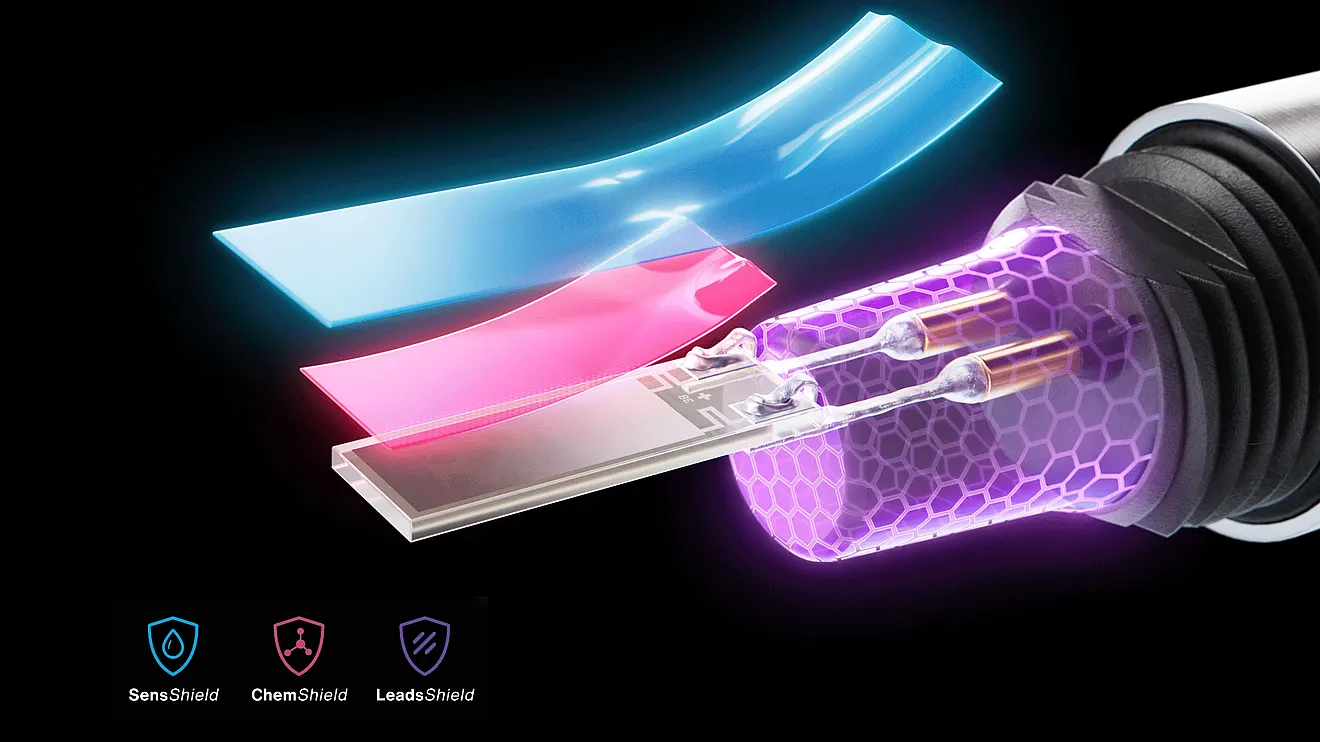
These technologies address different sources of measurement deterioration and can be selected or combined according to the application.
For example, E+E offers configurations combining ChemShield and SensShield for particularly demanding industrial humidity measurements.
Rather than applying the same protection to every sensor, E+E matches the protection concept to the measurement task, helping balance durability, response characteristics and serviceability.
Which E+E Elektronik Sensors Feature ChemShield?
ChemShield is currently available for selected configurations of the following E+E Elektronik instruments.
| Product | Measurement | Typical applications |
|---|---|---|
| EE310 | Relative humidity and temperature | Industrial processes, climatic test chambers, pharmaceutical environments and chemically demanding humidity applications |
| HTP501 | Relative humidity and temperature | Industrial drying chambers, process monitoring and demanding industrial environments |
| EE360 | Moisture in oil and oil temperature | Hydraulic, lubricating, insulating and selected natural ester oils |
| EE364 | Moisture in oil and oil temperature | Compact inline moisture monitoring in hydraulic and lubricating oils |
| MOP301 | Moisture in oil and oil temperature | Transformer, hydraulic and lubricating oils, diesel fuel and industrial machinery monitoring |
ChemShield availability and suitability depend on the selected product configuration and process conditions. The chemical composition of the measured medium should be considered before selecting an instrument.
Is ChemShield Available for Dew Point, Air Velocity or Other Measurements?
E+E Elektronik offers a wide range of measurement technologies, including dew point, air velocity, air flow, CO2, pressure and temperature.
However, ChemShield is only available for selected humidity and moisture-in-oil sensors.
Other protection technologies, sensor designs and application-specific accessories may be more appropriate for these measurements.
How Does ChemShield Compare with Other Sensor Protection Methods?
Industrial sensor manufacturers use several approaches to minimise contamination-related problems.
Protective filters can reduce exposure to particles and droplets, while specialised coatings help protect sensitive surfaces. Some humidity sensors, including E+E’s HTS801, HTS401 and EE260 also use periodic heating to remove absorbed chemical contaminants.
These approaches are not necessarily interchangeable.
ChemShield provides a protective barrier against chemical influences, whereas chemical purge systems seek to remove certain contaminants after they have entered or accumulated within the sensing element.
The most suitable approach depends on the chemical environment, measurement requirements, response time and maintenance considerations.
E+E’s particular strength lies in its range of complementary protection technologies, allowing the protection strategy to be matched to specific sensor components and operating conditions.
Choosing the Right Sensor for Chemically Demanding Applications
When specifying humidity or moisture measurement equipment, measurement accuracy and operating range are only part of the selection process.
Engineers should also consider the chemicals present, their concentrations, operating temperature, exposure duration and whether the process involves cleaning agents, solvents or ageing oils.
The appropriate protection technology can help reduce measurement drift, support long-term stability and minimise unnecessary maintenance.
With ChemShield, E+E Elektronik extends its existing sensor protection portfolio to address chemical contamination in selected industrial humidity and moisture-in-oil applications.
Looking for reliable humidity or moisture measurement in a chemically demanding environment?
OmniSensors can help identify suitable E+E Elektronik measurement instruments and discuss the appropriate protection options for your application.
Contact OmniSensors to discuss your measurement requirements.