Cleanrooms are controlled contamination environments. They are essential for many industries which involve nanoscale production processes such as semiconductors and for pharmaceutical and biotechnology production and research and development purposes to prevent small particles from affecting the manufacturing and quality of a product or from posing a health risk.
What is cleanroom monitoring?
A cleanroom is engineered to have a low concentration of airborne particles, creating an isolated room that is well-controlled from contamination. EN ISO 14644 is the international standard which cleanrooms must conform to.
The monitoring process prevents the entry of contaminants such as dust and airborne or vapourised particles that would compromise the quality and performance of the material being handled.
How do pressure transmitters help with cleanroom monitoring?
Pressure transmitters are used to measure the differential pressure in clean room monitoring systems. A strict overpressure must be maintained to ensure cleanrooms do not become contaminated by inflow of contaminated air.
The two pressures to be measured are applied to opposite sides of a diaphragm, deflection of the membrane to either side relative to the resting position is recorded, the pressure is calculated via a microprocessor and output is analogue. To guarantee longterm reliable readings, the zero point stability needs to be maintained. Halstrup Walcher’s differential pressure transmitters undergo a cyclical self calibration routine using a solenoid valve which switches the same pressure on either side of the diaphragm to re-establish the zero point.
In many cleanroom environments, there will be a series of mini-environmental zones with differing pressure levels depending on the sensitivity of the materials.
The accuracy of monitoring equipment is highly regulated to ensure that the end product maintains its quality and does not pose a health risk. As a result, continuous monitoring is standard practice, with measurements transmitted to a control module.
How to Set Up Differential Pressure Transmitters in Cleanrooms
The preferred location for measuring humidity and temperature is in the exhaust air duct because the value obtained here reflects the climate of the room as a whole. The simplest option is to install differential pressure sensors for a number of clean rooms or a series of mini-environments within a control cabinet
Installing differential pressure transmitters in a control cabinet offers two advantages:
- The “pneumatic zero potential“ described above (for maintaining clear pressure intervals in several zones) is extremely easy to implement. All pressure transmitters are connected via a short length of tubing to provide the same pressure reference value.
- Calibration (which is obligatory every year in many cleanrooms) can occur outside the cleanroom and can be completed quickly as the pressure transmitters are conveniently arranged next to each other.
There are four essential requirements of differential pressure transmitters for cleanrooms or mini environments:
- Simple installation – A narrow compact pressure transmitter “disk module“ which enables a large number of units to be installed alongside each other in a cabinet
- Data accuracy – A stable membrane and automatic zeroing is necessary even in minimum measurement ranges.
- Reliability – Requires Solenoid valves to maintain the zero point by regular automatic zeroing.
- Two Analogue Outputs – Allowing the building control and monitoring systems to receive independent signals.
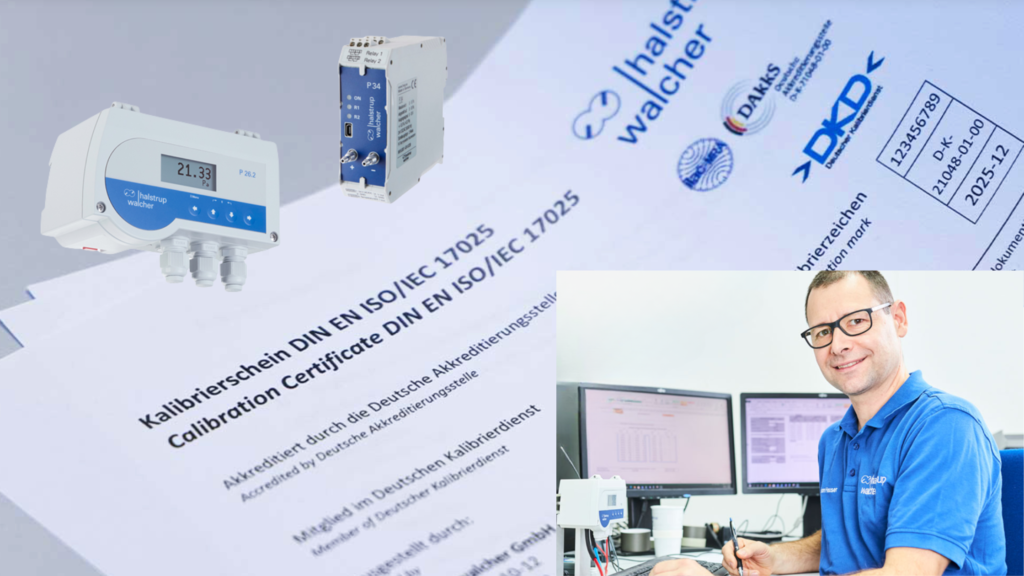
We recommend the P34 Differential Pressure Transmitter from Halstrup-Walcher as a product for installation within a control room cabinet.
It offers differential pressure monitoring and reports all types of overpressure while monitoring flow rates. Its compact design allows a group to be installed easily, monitoring several mini environments continuously.

We also supply a compact differential pressure sensor, the EE610 from E+E Elektronik which has a lower accuracy but is lower cost and offers a digital interface in addition to analog outputs.
In addition to ensuring a constant overpressure is maintained, temperature and humidity standards also apply to cleanrooms to ensure performance. In the absence of these controls the following issues can arise:
- Microbial growth
- Static build-up
- Condensation of water, which might then cause the clumping of powders leading to production delays and the potential for spoilage to occur
- Evaporation of solvents
- Uncomfortable working environment for employees which could result in shivering or sweating resulting in further particle contamination, also mistakes leading to lower quality products and production delays.

We offer a range of humidity and temperature sensors for use within cleanrooms.
The EE220 with pluggable interchangeable EE07 probes for temperature and RH
The EE 23 cost optimised humidity and temperature transmitter
The EE072 humidity and temperature probe with digital interface
The EE074 s/s temperature probe.
If you require advice or more information about installing pressure, humidity or temperature monitors in a cleanroom, please get in touch with us at Omni Sensors and Transmitters. We have a wide range of premium products and can help you select the transmitters most suitable for your needs.