Paper manufacturing is a complex process requiring close attention to moisture control. Measuring and controlling moisture in paper production and the converting and printing process can significantly improve the quality of the finished product.
This article examines how moisture affects paper properties and the best technology that can be used to measure moisture during different stages of production.

How can moisture affect paper properties?
Paper is hygroscopic, meaning it readily absorbs moisture from its surroundings. The amount of moisture absorbed will depend on environmental factors such as humidity and temperature.
The grade and type of paper also impact moisture absorbency due to weight, raw materials and surface treatments.
Moisture levels affect the resulting paper’s weight, dimension, flatness, conductivity, strength and fold.
Let’s look more closely at how water affects paper properties:
Dimensions
A 10% change in RH causes paper fibres to absorb moisture, increasing the paper’s width by 0.1% to 0.2%. This change will cause misregistration in printing.
Flatness
Uneven moisture absorption causes fibre expansion so that the wetter side will curl towards the dryer side.
Equilibrium occurs when the moisture is evenly distributed, allowing the paper to flatten.
Wavy edges will form on paper if moisture is allowed to be absorbed at the edge of a stack. It often occurs when the paper is over-dried, cold, or unwrapped in a warm or humid press room.
Tight edges arise when sheets of paper are exposed to low humidity conditions. Low humidity results in moisture desorbing from the edges of the sheets into the air and can occur in winter if the RH drops, especially in cold press rooms.
Conductivity
Paper is a semiconductor that gathers a static charge on its surface from contact and separation during processing or converting operations.
It commonly occurs when a very dry and cold paper is processed in low humidity conditions, particularly less than 35% RH.
A static charge increases the attraction between sheets, leading to separation problems. It causes feeder trip-offs, jams, misfeeds, and print voids from surface attraction to airborne contaminants and post-processing paper handling.
Some paper types are more prone to static build-ups, such as lightweight, large-sheet and gloss-coated papers. Gloss is the most challenging because the coating further insulates the raw paper fibre and the smooth surface offers a high contact area with less weight.
You can manage static build-up by maintaining adequate press room moisture levels to increase conductivity which helps dissipate static charge.
Strength
Paper’s tensile strength (TS) decreases as moisture content increases, meaning it will tear more easily.
Foldability
Paper and cardboard with too little moisture will become brittle, causing them to break when folded, leading to packing problems.
Measuring Moisture to Enable Adequate Moisture Control During Production
Having established that the physical quality of paper is affected by moisture, it follows that moisture control during paper production, storage and conversion or printing is essential.
It is vital to remember that moisture control during production will not be enough to prevent problems, as it can also be affected during storage before further processing. Moisture will impact the efficiency of printing and converting operations and affect the product’s final quality.
Moisture measurements should be taken through every stage of the process, including storage and transportation, to ensure corrective action can be taken if needed.
Problems caused by lack of moisture control during processing:
- High moisture levels will extend ink drying times, while low moisture can prevent inks, paints and coatings from saturating the paper adequately.
- Adhesion properties such as the polyethene film laminated on a coated paperboard used in Tetra Pak packaging can be affected.
- Incorrect moisture levels can result in the wastage of materials and create paper jams and machine blockages that hold up production.
Stages where measurements and corrective actions can be helpful include:
- At the end of a paper line on the warm running rolls or a sheet taken from the roll.
- On the winder that converts the parent reels where the paper or board machine cuts off the paper into narrower rolls. Here, the climate, handling and storage conditions will impact moisture content most.
- On stationary rolls or stacks of paper and cardboard before conversion or printing. Here optimal moisture levels between 4-6% are required to make the process go smoothly.
- When paper traders buy and sell paper and paperboard based on weight.
Optimum Moisture Levels in Paper
Different paper grades have varying target moistures.
- Digital printing papers have a target moisture level of 4.5% to ensure minimal curl, effective toner adhesion and good image quality.
- Offset printing papers have an optimum moisture level of between 5.5% and 6%
- Corrugated card has an optimum moisture level of 7%
- Tissue paper has a target moisture level of between 2% and 7%
- Copy paper has an optimum moisture level of 6%
What actions can correct the moisture level before and during converting operations?
- Use an air moisturising system in paper processing environments to increase humidity.
- Turn up the thermostat in the press room if humidity levels are too high so that the maximum heat is 29°C to reduce RH%.
- Use a re- moisturising system on the paper web. Recondition the paper by applying steam or a fine water spray.
The Best Measurement Technology for Monitoring Moisture Levels in Paper Production and Processing
Let’s look at the different methods of measuring moisture during paper production and evaluate the advantages and disadvantages of each one. The technology you choose will depend on your budget, expertise and requirement for accuracy.
Oven Dry Method
Method: Take a sample of paper to be weighed and dried to constant weight within a convection oven at 105 °C. The difference in the weight of the paper before and after drying will be due to moisture.
You express the difference as a percentage of the dry weight of the paper. This thermogravimetric measurement technique is a primary reference technique used to calibrate moisture measurement devices that use different measurement technologies.
Advantages: You can analyse several samples simultaneously.
Disadvantages: It is time-consuming and produces errors due to sampling and sample handling. Other non-moisture volatiles can be lost besides moisture, and it is a destructive test as the samples will be unusable.
LOD (Loss on Drying)
Method: A paper sample is placed within an infrared drier, draining off all free moisture. The weighing and heating are carried out in one continuous operation.
Advantages: It reduces sample handling and provides a more rapid analysis than an oven test.
Disadvantages: Small sample size means more possibility of non-representative moisture value. Weighing errors are higher as a % of the total mass, and as with the oven test, non-moisture volatiles are also lost.
Karl Fischer (KF) Test
Method: This is a wet chemistry analysis requiring an experienced lab technician. The water is chemically extracted from the paper and compared with the initial mass or volume.
Advantages: If this test is carried out by a skilled operator, the results are very accurate.
Disadvantages: A skilled operator must carry out the tests and ensure the system is well-calibrated. The tests are time-consuming and involve a small sample size which may not be representative. Chemical reagents are expensive to purchase and must be disposed of after use.
NIR Moisture Meter
Method: The meter produces an online measurement where the sample is maintained at a constant distance and angle to the sensor. The sensor will provide a moisture profile with an accuracy that is dictated by the quality of the initial sensor calibration vs the primary reference.
Moisture content is determined by absorption of NIR energy over a narrow moisture-specific wavelength range.
Advantages: It provides an instantaneous and continuous measurement in the machine or cross web direction (if attached to a scanner) and is non-destructive, reducing wastage.
Disadvantages: It is not portable and must act as a dedicated sensor. It requires individual calibrations for different paper grades and different colours. It is expensive.
Microwave
Method: This method is used for on and at-line measurement of moisture in paper.
Advantages: The test is instantaneous and non-destructive.
Disadvantages: It requires calibration for different paper types and grammages and is height and temperature-dependent. It is expensive.
Capacitive Dielectric Meters
Method: It is suitable for online but also commonly used within portable and lab instrumentation. It measures moisture as differences in dielectric coefficient as the drier and wetter paper is placed between 2 electrodes causing the electric field strength to change.
Advantages: It is instantaneous, non-destructive, low-cost, portable and versatile. The measurement technology lends itself to a variety of instrument designs, including probes which can be used to penetrate the interior of paper stacks
Disadvantages: It is temperature (but automatically temperature compensated), pressure and vibration dependent.
If you are interested in finding out more about capacitive low-cost portable moisture meters, please visit Omni Sensors and Transmitters or call us on 01926 614263 for more information.


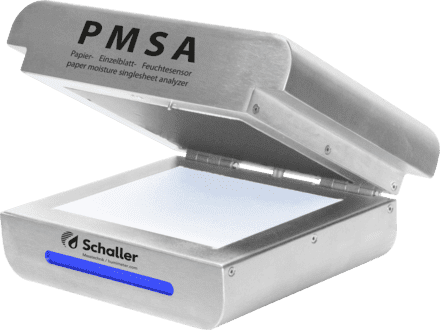
We stock meters including the RH5, RH6, PM5, PMP and PMSA for use in paper production, storage facilities, print rooms and converting operations that either operatives or traders can use.