Meteorology Sensors and measuring instruments used in climate research and weather observation must meet particularly high requirements.
Adverse environmental conditions, low temperatures, contamination, dew, and frost/ice are all influencing factors that climate sensors need to address and positively respond to.
High measurement precision and short response times are paramount in climate measuring technology.
Heated humidity sensors, such as those from Austrian sensor manufacturer E+E Elektronik, are unique in structure and mode of operation. They achieve the high-performance levels required for meteorology applications.
Heated Humidity and Temperature Sensors for Weather Stations and Weather Warning Systems
Dual Heating System Prevents Condensation or Icing
For its meteorological humidity and temperature sensors, E+E Elektronik relies on a dual heating system for the sensing element and the probe.
The core of the meteorology sensor is a heated thin-film sensing element that combines a capacitive humidity sensing element and a heating resistor on a shared substrate. When dew formation conditions are approached, the surface temperature of the sensing element is increased by adaptive heating until a non-critical temperature range is reached.
The heated sensing element combined with the permanently heated probe prevents condensation or icing on the sensing element or on the sensing head in case of fog, dew, rain or snowfall.
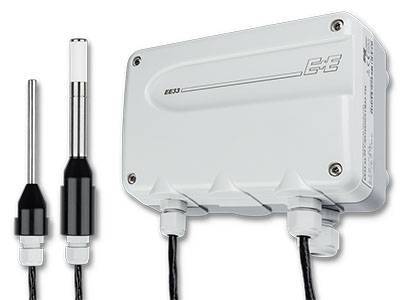
EE33-M for high-end temperature and humidity meteorological applications
Stable Measuring Performance in the High Humidity Range
With continuous high humidity >90 % RH there is a risk of measurement drift with unheated sensors. Heating eliminates this possibility ensuring accurate and reliable readings whatever the conditions.
Short Response Time in the Low-Temperature Range
Another advantage of heating is the short response time, especially in the low-temperature range.
This is particularly important for ice warning systems at airports or in road traffic, where the meteorology sensors used for weather monitoring must react quickly to temperature changes.
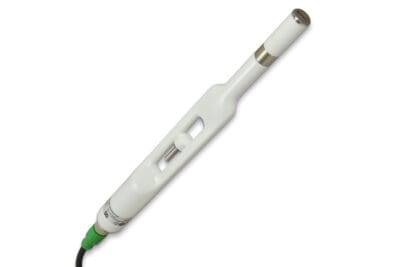
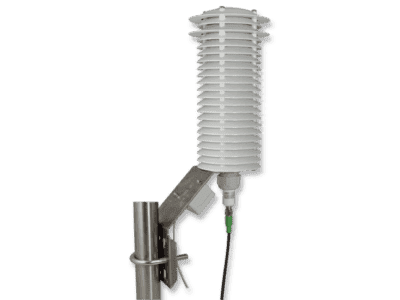
Outdoor Use – Weather, Dust and Corrosion Can Influence the Measurement Results of Meteorology Sensors
Radiation Shields Are Mandatory for Protection against Weather Influences
For meteorology sensors used in outdoor applications for humidity and temperature measurement, the use of radiation shields is a must.
They protect the sensors from weather influences such as rain or direct and indirect thermal radiation and prevent environmental conditions from affecting the measurement results.
Meteorology sensors from E+E Elektronik are compatible with standard radiation shields.
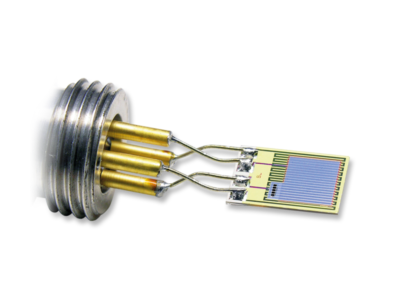
Sensor Coating Protects against contamination and Corrosion
Besides weather influences, meteorological sensors are also exposed to dust, dirt and possibly salty air in offshore applications or weather stations near the sea.
Deposits on the sensing element not only affect the measurement result but can also lead to corrosion of many humidity sensing elements but not those within E+E meteorology sensors.
E+E meteorology sensors feature a proprietary sensor coating.
This special coating protects the humidity sensing element and its leads against corrosive and electrically conductive pollution, significantly improving the long-term stability and service life of the sensors.
Are you interested in meteorology sensors? We would be happy to advise you. Please call us on 01926 614263 or email us at sales@sensorsandtransmitters.com