
The UK Government, following the Paris Agreement, passed The Climate Change Act intending to reduce greenhouse gas emissions by at least 100% of 1990 levels (net zero) by 2050. The hope is to limit global warming to +1.5 degrees. It’s an ambitious but essential target if the adverse effects of climate change are to be minimised.
These bold objectives have driven the energy industry to seek clean alternatives, with fuel cell energy generation being considered a growing viable, clean energy source. As fuel cell energy is industrialised on a larger scale, there is increasing demand for reliable measuring devices to improve efficiency.
In this article, we will explore how fuel cells provide cleaner energy and explain how humidity sensors can be used to increase their efficiency.
How does fuel cell energy contribute to Net Zero?
Clean energy focuses on reducing harmful emissions, especially CO2. Compared to conventional power generation, fuel cells are emission free and, therefore, better for the environment.
Fuel cell energy production contributes to a more sustainable future by decarbonising power and producing hydrogen worldwide.
Fuel cells have many applications, with the vehicle industry being one of the primary users.
How do fuel cells work?
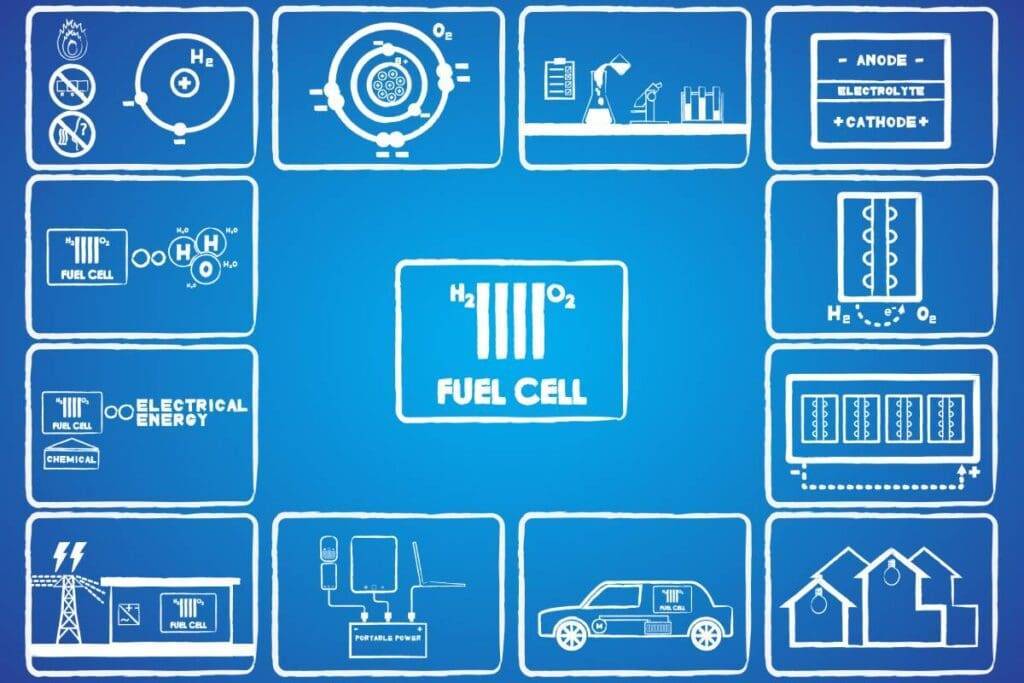
Essentially, fuel cells convert chemical energy into electrical energy and heat, no combustion is involved. A proton exchange membrane (PEM) fuel cell transforms the chemical energy liberated during the electrochemical reaction of hydrogen and oxygen to electrical energy.
Here are the main steps in fuel cell energy production:
- A hydrogen stream (fuel) is delivered to the anode where it is catalytically split into protons and electrons.
- The protons permeate through the PEM to the cathode side of the membrane electrode assembly (MEA) and the electrons travel along an external load circuit to the cathodeside of the MEA providing the current output of the fuel cell. Meanwhile, a stream of oxygen is delivered to the cathode side of the MEA. Oxygen molecules react with the permeated protons and the electrons arriving through the external circuit to form water molecules.
- Electrons discharge via an external circuit, creating an electrical current.
The stability of water and temperature inside the fuel cell influences efficiency. Naturally, accurate monitoring is critical to retain the correct equilibrium.
Fuel cell energy production creates a challenging environment for measuring devices. Sensors must be designed to withstand the conditions whilst being sensitive and accurate under duress.
How to Improve Efficiency in Fuel Cell Energy Generation
The efficiency of fuel cell energy production has several implications.
- Temperature and Humidity Levels -If these are not adequately controlled, both the catalyst and membrane will age faster, leading to loss of power or cell destruction.
- Water Content – Maintaining water levels (humidity) is essential for the proton conductivity of the membrane. Losing water will affect the performance and life of a fuel cell. The more water, the longer the life of a fuel cell and the more efficient it will be.
Humidity is maintained by introducing a water pump to keep the gases humid. A humidity sensor is vital to ensure there is continual monitoring of humidity levels for adjustments to be made as needed.
What type of humidity sensor works best in fuel cell energy generation?
When choosing a sensor for fuel cell energy production, the main requirement is selecting a device designed to operate accurately in high humidity environments.
In particular, you should consider how sensors retain stability in challenging conditions while maintaining precision measuring capability.
When buying a humidity sensor for fuel cell energy generation, remember the following points:
- You must stop the membrane from drying out
- High humidity causes significant challenges for many sensors
At Omni Sensors and Transmitters, we offer a wide selection of quality sensors.
Our E + E Elektronik humidity sensors have controlled heating of the sensing elements to maintain accuracy in a humid environment. They have significant advantages for use in fuel cell energy production:
- Long-term stability in a humid environment
- Quick recovery in the event condensation occurs
- Robust and can cope with dirt thanks to solid casing and a unique sensor coating for protection
- Excellent reputation
EE33-T17 – This sensor is optimised for reliable humidity and temperature measurement in applications with high humidity, and is ideal for test benches. Condensation on the monolithic humidity sensor and the filter cap is prevented by controlled heating of the sensor.
HTE501 – This sensing element is designed for high precision and is suited to customised solutions. It has an accuracy of up to ± 1.8 % RH (incl. hysteresis) and ± 0.2 °C maintained by an integrated heater and a unique sensor coating. It can be used downsteam of the humidifier in the oxygen supply, monitoring RH%, temperature and dew point.
Investing in one of our sensors is worthwhile and offers excellent value for money in the long term:
- Extending the life of the fuel cell membrane
- Less maintenance required
- Enhanced fuel cell performance
In addition to recommending a humidity sensor we can also provide metal oxide gas sensors for integration into a hydrogen leak detector to improve the safety and efficiency of both the production process and operation of fuel cell stacks.
Call us on 01926 614263 to discuss your options and get more information about our humidity and gas sensor range.