Plant nurseries and farms use greenhouses to enable the all-year-round growth of ornamental and edible plants.
To establish and maintain the best conditions, growers must monitor humidity and temperature, but it is also beneficial to use carbon dioxide (CO2) to promote plant growth. CO2 fertilisation speeds up photosynthesis and improves water efficiency, increasing the yield and accelerating the growth cycle.
This guide will explore how CO2 fertilisation works and how to measure and monitor CO2 in greenhouses.
How CO2 achieves higher Yields in Greenhouses
CO2 is a vital component of photosynthesis, along with light and water.
A reduction in CO2 means plants produce less glucose, leading to slow growth. Higher concentrations of CO2 cause plants to produce more glucose leading to faster growth, improved root formation, earlier flowering and a higher yield.
CO2 fertilisation is the process where CO2 is increased to improve productivity. It is particularly beneficial in winter when natural light levels are lower.
CO2 is generated artificially by introducing natural, liquid or pure gas into the greenhouse. The concentration required will depend upon the type of plants being grown. Vegetables typically benefit more from higher CO2 levels compared to ornamental plants.
A simple calculation for CO2 concentration is as follows:
Higher mass growth requires higher CO2 concentrations between 600 and 1200 ppm.
How to Monitor CO2 levels in a Greenhouse
CO2 fertilisation requires continuous measuring and monitoring to maintain appropriate levels.
It is crucial not to introduce too much CO2 as this will lead to slow growth and underdevelopment. It is also vital to track concentration to improve efficiency and reduce costs, as generating CO2 is costly.
Monitoring is also essential for health and safety since high levels of CO2 exposure is potentially harmful and can cause people to suffer serious health problems. The maximum legal concentration of CO2 is 5000 ppm.
Which CO2 sensors are recommended for monitoring CO2 in greenhouses?
CO2 sensors face particularly challenging conditions in greenhouses due to their natural environmental state. Sensors will be exposed to humidity, condensation and contaminants such as fertilisers and pesticides.
Exposure to these conditions can impact the accuracy and reliability of many sensors.
When choosing a Carbon Dioxide sensor for monitoring CO2 concentration in a greenhouse, you must consider the following:
- A parameter range wide enough for your needs
- Accuracy in greenhouse conditions
- Stability in greenhouse conditions
- Resistance to humidity and other contaminants
- Response time to changes in CO2 levels
- IP65 protection
- Maintenance requirements and ease of calibration
- Integration features
At Omni Sensors and Transmitters, we stock a wide range of CO2 sensors. One of our recommended choices for monitoring carbon dioxide in greenhouses is the EE872 4 https://sensorsandtransmitters.com/product/ee-elektronik-ee872-4-in-1-modular-probe/in 1 modular Probe for CO2, Humidity, Temperature and Ambient Pressure
Made by E + E Elektronic, it has been developed to withstand challenging conditions such as those found in greenhouses. It is resistant to contaminants and will counteract the effects of ageing and pressure to improve accuracy.
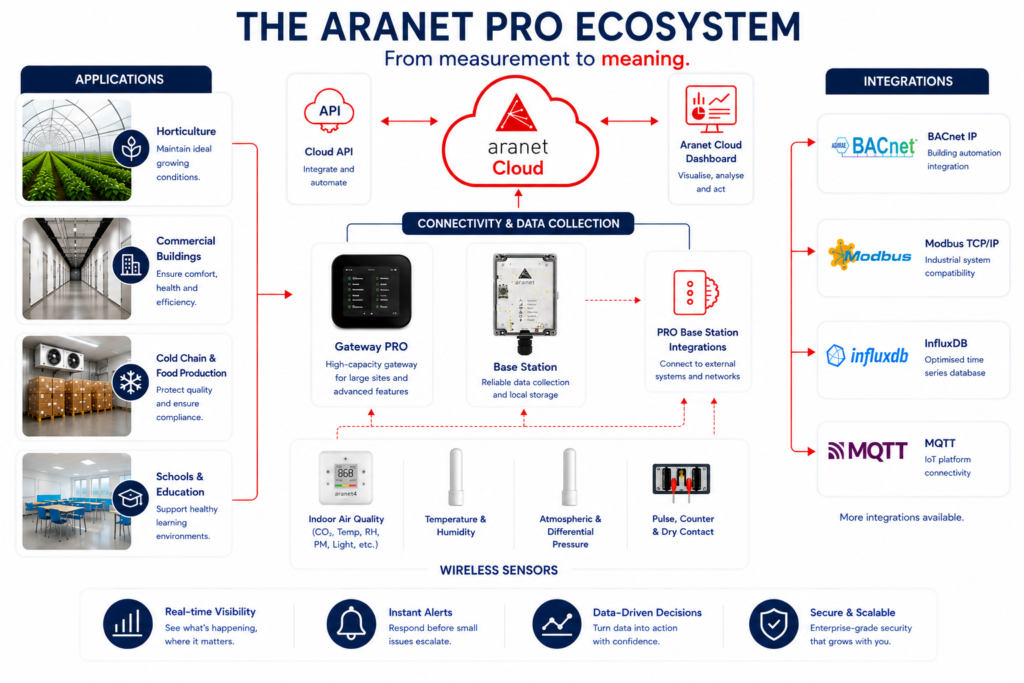
The EE 820 with robust IP54 enclosure, special filter and analogue outputs and the wireless Aranet CO2 and temperature sensor are also designed for use in greenhouses and offer different features; for example lower cost and wireless communications.