
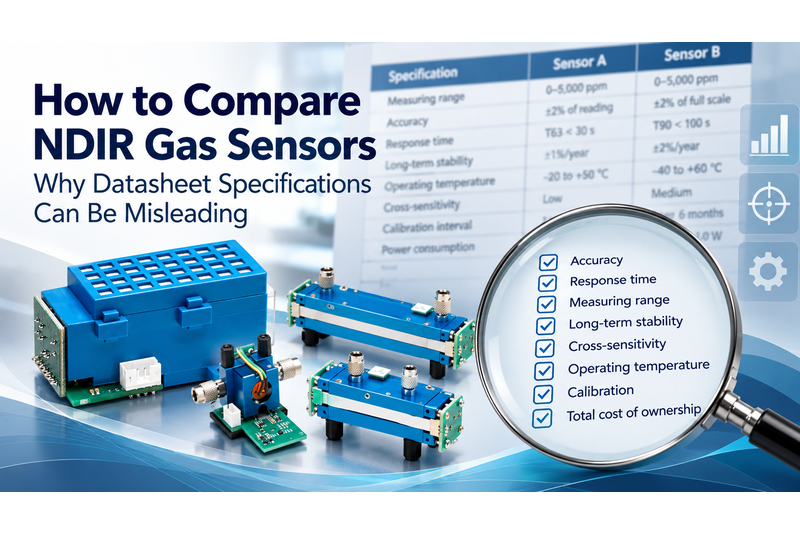
To compare NDIR gas sensors effectively, it is necessary to look beyond specifications on a datasheet. Two NDIR (non-dispersive infrared) gas sensors may offer similar measuring ranges, accuracy and response times, yet perform quite differently once installed.
Why? Because sensor performance depends not only on the published figures, but also on how they are defined, measured and applied in real operating conditions.
For OEMs, design engineers and system integrators, understanding these differences can help avoid measurement errors, unnecessary calibration costs and expensive design changes.
In this article, we examine seven important considerations when comparing NDIR gas sensors, which are widely used in industrial gas monitoring and analysis. While some of these principles also apply to other gas sensing technologies, their specifications and evaluation criteria can differ.
1. Gas Sensor Accuracy: Percentage of Reading or Full Scale?
Accuracy is often one of the first specifications considered when selecting an NDIR gas sensor. However, two sensors both claiming ±2% accuracy may deliver very different results.
The key is understanding what the percentage refers to:
- % of reading: Accuracy is calculated against the actual measured concentration.
- % of full scale: Accuracy is calculated against the maximum value of the sensor’s measuring range.
For example, consider a CO2 sensor with a measuring range of 0 to 5,000 ppm, measuring a concentration of 500 ppm.
| Accuracy specification | Possible deviation |
|---|---|
| ±2% of reading | ±10 ppm |
| ±2% of full scale | ±100 ppm |
Although both sensors advertise ±2% accuracy, the potential measurement errors differ significantly.
Some sensors also specify a combined accuracy, such as ±2% of reading ±50 ppm. This includes a fixed error component that can become particularly significant at low concentrations.
What to check: Is accuracy expressed as a percentage of reading, full scale or a combination? Does the specification apply across the entire measuring range?
2. Response Time: What Is the Difference Between T90 and T63?
Response time indicates how quickly a gas sensor reacts to a change in gas concentration.
Two commonly used specifications are:
- T90: Time required to reach 90% of the final response.
- T63: Time required to reach approximately 63% of the final response.
A T63 value will normally be shorter than the corresponding T90 value, so comparing these figures directly can give a misleading impression of sensor speed.
Importantly, the response time quoted on a datasheet may not represent the response time of the complete measurement system. Sampling tubes, filters, gas flow rates and internal chamber volumes can all introduce delays.
For applications such as industrial process monitoring and safety systems, the response time at the actual measurement point may be more important than that of the sensing element alone.
What to check: Is the quoted response time T90 or T63? Under what test conditions was it measured, and how might installation affect the final response?
3. Long-Term Stability: Understanding Sensor Drift and Calibration
Sensor drift describes changes in measurement output over time, even when the gas concentration remains unchanged.
Two important characteristics are:
- Zero drift: Changes in the baseline reading.
- Span or sensitivity drift: Changes in the sensor’s response to a known gas concentration.
When comparing datasheets, check whether drift is specified per month, per year or over the expected service life. Also distinguish between typical and maximum values.
An NDIR sensor with good long-term stability may require less frequent recalibration, potentially reducing maintenance costs and downtime.
However, calibration requirements depend on the application, operating environment, manufacturer’s recommendations and any applicable standards.
What to check: How is drift specified, what calibration interval is recommended, and what are the likely maintenance requirements over the sensor’s lifetime?
4. Measuring Range: Is a Wider Range Always Better?
Not necessarily.
An NDIR gas sensor designed to measure high gas concentrations may not provide the resolution or accuracy required for low-level measurements.
For example, a sensor designed for percentage-volume measurements may have different optical and calibration characteristics from one optimised for ppm-level detection.
Selecting a sensor with an unnecessarily wide measuring range can compromise performance at the concentrations that matter most.
What to check: What is the normal operating concentration? What are the lowest and highest concentrations that must be measured, and is the required accuracy maintained across that range?
5. Cross-Sensitivity: Could Other Gases Affect the Reading?
In many applications, the target gas is not the only gas present. Other gases, water vapour and changes in the surrounding gas mixture may influence the measurement.
This is particularly important in industrial gas analysis, where gas composition can vary during normal operation.
NDIR sensors use infrared absorption characteristics to measure suitable target gases. Optical filters and wavelength selection can provide good selectivity, but potential interference still needs to be considered. The underlying relationship between absorption and concentration is described by the Beer-Lambert law.
A datasheet listing only a few interfering gases does not necessarily indicate superior selectivity. It may simply reflect the gases included in the manufacturer’s testing.
What to check: Which other gases and vapours may be present, at what concentrations, and how could they influence the measurement?
6. Operating Temperature Versus Temperature-Compensated Accuracy
A sensor’s specified operating temperature range is not necessarily the range over which its quoted accuracy is maintained.
For example, a sensor may function between −20°C and +60°C, while its stated accuracy applies only over a narrower temperature range.
Temperature changes can influence NDIR measurements and may require compensation.
This distinction is particularly important for outdoor monitoring equipment, industrial installations and applications involving significant temperature fluctuations.
What to check: Does the accuracy specification apply across the complete operating temperature range? Is temperature compensation integrated into the sensor or required within the instrument electronics?
7. Reference Conditions: Are the Specifications Relevant to Your Application?
Datasheet performance figures are normally established under defined laboratory conditions.
These may include specified values for:
- Ambient or process temperature
- Atmospheric or sample gas pressure
- Relative humidity or moisture content
- Gas flow rate
- Calibration gas composition
Actual operating conditions may differ significantly.
For example, changes in gas pressure, humidity or sample temperature can influence NDIR measurement performance. Depending on the application, additional compensation or gas conditioning may be necessary.
What to check: Under which conditions were the published specifications obtained, and how closely do these represent the intended installation?
Beyond the Datasheet: Consider the Total Cost of Ownership
For OEMs and equipment manufacturers, selecting an NDIR gas sensor also involves evaluating its impact on the finished product.
A lower initial sensor price does not necessarily translate into a lower overall cost.
Other considerations include calibration frequency, expected service life, integration requirements, power consumption, technical support and replacement costs.
Choosing a sensor that is well matched to the application from the outset can help minimise development time, maintenance requirements and long-term operating costs.
How to Compare NDIR Gas Sensors for Your Application
Before comparing products, it is helpful to define the measurement requirements as clearly as possible.
| Application requirement | Why it matters |
|---|---|
| Target gas and concentration range | Determines suitable sensor designs and measurement ranges |
| Other gases and moisture present | Helps assess potential cross-sensitivity |
| Operating temperature and pressure | Establishes compensation and environmental requirements |
| Required response time | Influences sensor selection and sampling system design |
| Installation and electrical interface | Determines integration requirements |
Providing this information to a specialist gas sensor supplier can make the selection process considerably more straightforward.
Frequently Asked Questions About NDIR Gas Sensors
Why can two NDIR gas sensors with the same accuracy specification perform differently?
Because accuracy may be defined against the measured reading or full-scale range and may apply under different reference conditions. Temperature, pressure, humidity and gas composition can also affect performance.
What is the difference between T90 and T63 response time?
T90 is the time taken for a sensor to reach 90% of its final response following a concentration change, while T63 represents approximately 63%. They cannot be compared directly without considering the sensor’s response characteristics.
How often should an NDIR gas sensor be calibrated?
Calibration frequency depends on the sensor design, stability, operating environment, required accuracy and applicable standards. Always refer to the manufacturer’s recommendations and the requirements of the finished measurement system.
Are NDIR gas sensors suitable for industrial gas analysis?
Yes. NDIR technology is widely used for measuring infrared-active gases in industrial processes, environmental monitoring and gas analysis. Suitability depends on the target gas, concentration range, gas mixture and operating conditions.
What information is needed to select an NDIR gas sensor?
At minimum, identify the target gas, required measurement range, other gases present, environmental conditions, required response time and installation requirements.
Choosing the Right Gas Sensing Technology
NDIR is one of several gas sensing technologies available, and the most suitable choice depends on the target gas, measurement requirements and operating environment.
Alongside smartGAS NDIR sensors, Omni Sensors & Transmitters supplies other gas sensing technologies from manufacturers including Figaro, Angst+Pfister and NevadaNano, helping OEMs and equipment manufacturers identify solutions suited to their specific applications.
Selecting an NDIR Gas Sensor with Confidence
The best NDIR gas sensor is not necessarily the one with the most impressive datasheet figures, but the one whose performance best matches the intended application.
At Omni Sensors & Transmitters, we work with specialist manufacturers, including smartGAS, whose NDIR gas sensing technologies support a wide range of industrial monitoring and gas analysis applications.
Our team can help customers evaluate measurement requirements, understand sensor specifications and identify suitable solutions for integration into their equipment.
Need Help Selecting an NDIR Gas Sensor?
Explore our smartGAS sensor range or contact Omni Sensors & Transmitters to discuss your application.
This article was developed with reference to smartGAS Mikrosensorik GmbH’s original article, Selecting a Gas Sensor: Why Two Datasheets Are Not Comparable.


