Zero Carbon Farms run a microgreens salad and herb growing operation in the most unusual of places, in former WWII air raid shelters located 33m below ground in central London. Through their sustainable growing and on-site packaging practices and supply to local retailers and restaurants, Zero Carbon Farms have exceeded their Zero carbon footprint, in 2021 they became a Certified Carbon Neutral + Organisation, which means they are net carbon negative.
The history behind the business
The idea for the business was sprung when Richard Ballard, a former film student involved in a project filming “Hidden spaces in London” discovered the tunnel shelters. Both Richard and his friend Steven Dring shared a common interest in the ideas of two influential academics at that time: Dickson Despommier & Jeremy Rifkin. In 2010 Rifkin published “The Third Industrial Revolution” a durable sustainability plan to counter the major global concerns; climate change, energy security and economic crisis, the same year Dickson Despommier published ‘The Vertical Farm: Feeding the World in the 21st Century. The opportunity to implement the ideas and establish a sustainable subterranean growing business in the disused shelters within the heart of London was not to be missed.
Optimising environmental growing conditions
In 2015, after a period of 2-3 years during which trial crops were grown, the commercial growing operation was initiated within a section of one of the 8 tunnel shelters.
Due to the atypical growing environment, it is essential that temperature, ventilation, humidity, irrigation, and lighting conditions are monitored and optimised for the plant varieties grown, also that the growing area is kept clean and free of bulky equipment and cabling that might introduce biohazards, impacting food safety.
Sensor monitoring equipment
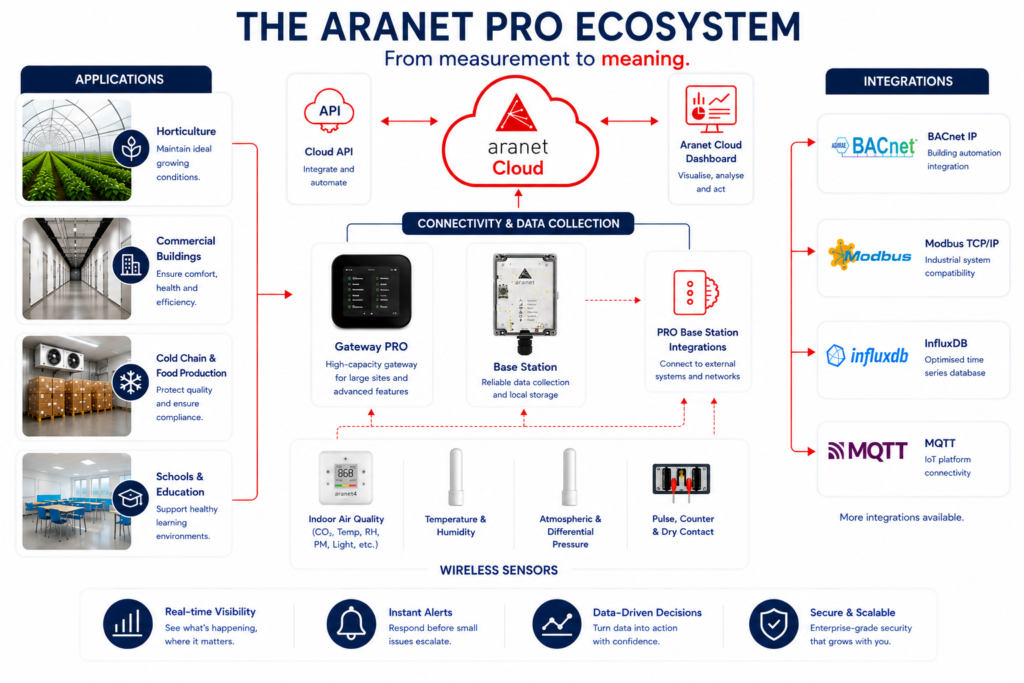
Zero Carbon Farms use Aranet wireless sensors, offering:
- Easy installation and deployment – no hard wiring and simple pairing procedure to the router.
- Flexibility – manoeuvrability of the sensors
- Compactness – small footprint and food-safe design.
- Robustness – rugged sensor technology with IP67 enclosures
- Cost-effectiveness – high performance: price ratio
- Low cost of ownership – changeover of batteries every 5-7 years.
- Phenomenal wireless signal strength
- PC and cloud-based (remote) central monitoring system
Aranet humidity/temperature and CO2 sensors, also third party E+E Elektronik air velocity probes with Aranet analogue to wireless converters capture all the data on the Aranet system. This data together with further information from other instrumentation and the expertise of the Cambridge Engineering Department and the Alan Turing Institute is fed into a data repository to create a time and spatial distribution data feed to not only map the current environment but also predict the environment up to 3 days ahead in the growing tunnel.
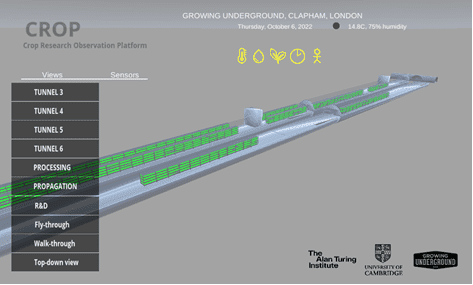
Current and Predictive mapping of environmental conditions
The 3d map shows temperature and humidity stratification within the growing space, this information is used to plan the most productive crop layout for the 14 or so different species according to their optimum growing conditions in addition to providing the means to apply fine control using supplementary fans, heating, or dehumidifiers. Currently, irrigation, lighting and dehumidification are automatically controlled whereas ventilation and heating are under manual control. The future plan is for fully automatic control.
This predictive modelling can circumvent drastic measures being undertaken when unusual situations arise, for example, this summer when the temperature exceeded 40 °C for over a week. Without the foresight afforded by the model, vents taking in warm outside air would have been closed to a minimum and the LEDs would have been turned off possibly resulting in damage to the crops. In actuality, ventilation was slightly reduced, LEDs weren’t switched off, the temperature below ground didn’t exceed 27 °C and the crop wasn’t adversely affected.
Please see further information on Zero Carbon Farms on the Envirotech website.