Cheesemaking is the production of cheese by using bacterial culture, enzymes and stabilizers to condense the milk proteins and fat and to preserve the cheese. It is a multi-step process which culminates in the ripening stage; storage in a cool and dry place, under controlled temperature and humidity. Ripening allows enzymatically induced changes in the protein and fat within cheese, which imparts a typical flavour, aroma, texture, etc. Cheese is aged for several months to years and under different climatic conditions since it determines the rate of ripening, weight-loss, rind formation, development of the surface flora and appearance, taste and texture. Moisture loss from the surface of hard cheeses can cause the cheese to form cracks.
Precise humidity control is important not only for achieving the desired characteristics in terms of taste, texture and appearance but also to minimise energy costs and maximise profits. If cheese is overdried, energy usage is higher and yield is reduced adversely affecting profits.
Storage time and conditions vary according to cheese type;
Cheddar; Temperature 4-8° C, RH% < 80%, ripening time 2-24 months
Emmental; Temperature 8-12° C, RH% 85-90%, ripening time 3-4 weeks followed by a temperature increase to 22-25° C for 6-7 weeks maintaining the same humidity level before dropping the temperature to 8-12° C again for several months.
Brie and camembert; Temperature 12-15° C, RH% 90-94%, ripening time 9-30 days
Blue cheese; Temperature 8-12° C, RH% 85-95%, ripening time weeks-months
Historically, caves, have been used as the ideal environment in which to age and store cheese and they continue to be used to this day, for example in the production of Roquefort in the Combalou caves in France but nowadays most storage areas are climate-controlled manmade structures comprising well-ventilated racking, humidifiers and both temperature and humidity sensors and control system. Stackable grids in polypropylene for food (cheese) aging racks are used for ripening, brining and drying cheeses allowing optimal ventilation and support of the products. Steam or adiabatic humidifiers can be employed, the latter uses a variety of technologies to introduce water into air, either by dispersing water droplets or by allowing water to evaporate from a wetted media, causing relative humidity (RH) levels to increase and air temperature (dry bulb) to decrease. This ultimately saves on energy usage and costs.
stainless steel recirculating air hygiene unit is able to cool, heat, moisten or dehumidify the air as required. The air is distributed via induction nozzles and therefore ensures an even and precise ripening climate.
Process of maintaining humidity levels within the ripening room
The air in the chamber is frequently renewed with air from outside which is typically warmer As the colder air within the ripening room holds less humidity than the incoming air, the air in the chamber will become saturated and cause condensation. In order to avoid this situation, relative humidity has to measured within the chamber and incoming air has to be both controlled and dehumidified. Note that dehumidifiers generally contain a built-in humidity sensor.
Humidity measurement challenges
High humidity levels and potentially condensing environments
Presence of ammonia gas, this will interact with a humidity sensor and potentially cause drift. Water needs to get in and out of the sensor, which means that other gases can too which blocks the active surface.
Humidity measurement solutions
Humidity sensors can struggle in aggressive high humidity, even the best capacitance sensors only achieve accuracies around +/- 2.0% above 90% RH. If you are concerned about accuracy, have found your measurement drifting or need to frequently replace sensors it may be time to consider the Electro-resistive sensor.
Electrolytic-resistive (ER) measurement works on a different basis to the capacitive sensor; electrolyte absorbs humidity and its resistivity changes as it dilutes. Response time is rapid, accuracy is of the order of +/- 0.8% in the region of 85-100% RH, and the sensor doesn’t drift in the presence of ammonia. Although calibration remains important it isn’t required at the same frequency as for a capacitance sensor.
Novasina manufactures this unique humidity sensor and provides it with a user-friendly rapid means of calibrating the sensor using an android mobile phone or a laptop.
Humidity measurement sensors – note all sensors include an NTC temperature sensor and temperature output.
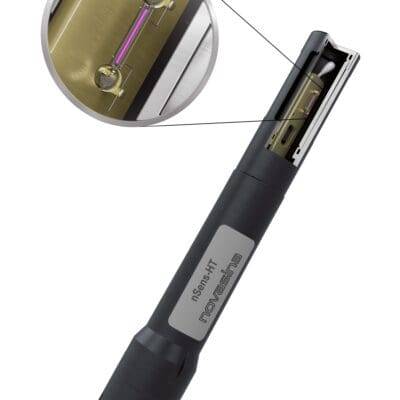 nSens-HT-EIH( heated element) – Drift-free, stable measurement in a persistent high humidity condensing environment. Ideal for applications requiring high precision and rapid response times.
Digital output (nSens-bus technology)
Typical accuracy: ≤1.2 % RH above 75% RH (-20-60°C)
nSens-HT-EIS – The non-heated equivalent of the nSens-HT-EIH – High precision, fast response and good stability over 0-100% RH. Not for use in persistent condensing environments.
Digital output (nSens-bus technology)
Typical accuracy: ≤0.8% RH (0-50 °C)
nSens-HT-EIM(stainless steel) – The HT-EIS probe housed in food grade stainless steel.
USB smart handle – Connect nSens probes to your Windows PC or Android Smartphone for real time measurement, data logging and calibration with the handle and a choice of USB-C or USB-A connector. Allows data transfer to any software (such as Labview) by using Novasina nBus protocol
Although the sensor itself only provides digital output, analog outputs are provided for process control by plugging the sensor cable into either a dedicated nlink-Analog IP or EC or up to 4 sensor cables into a Quantadat which also features a screen display and on-screen configuration.
If you enjoyed this article you can read our related blog – Ensure Salami quality and yield through accurate humidity and temperature control