
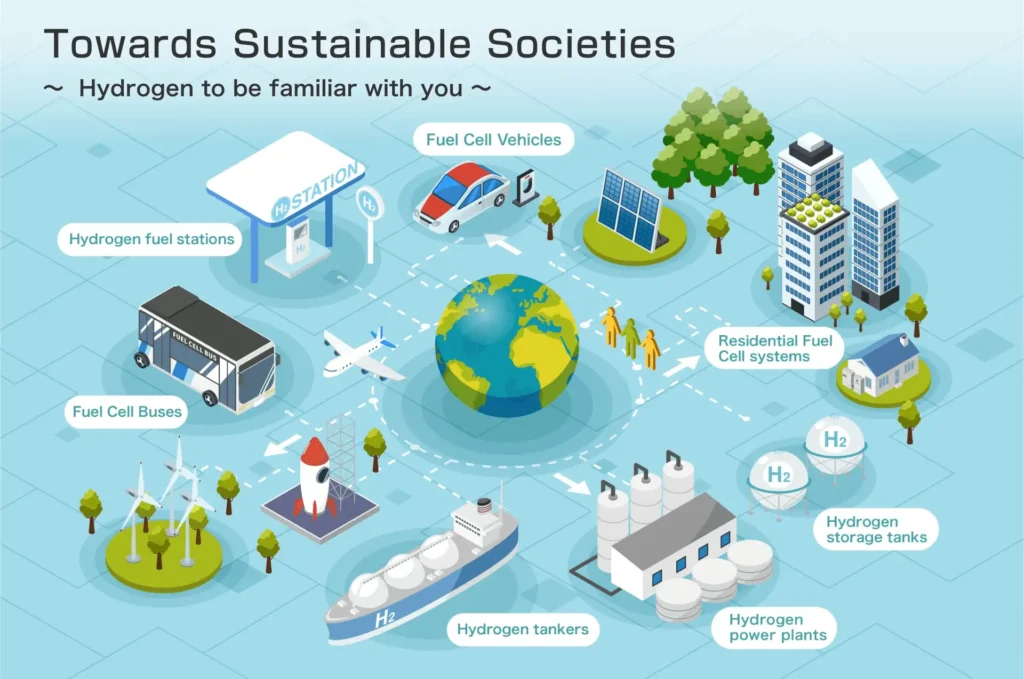
Hydrogen began to be seriously considered as a “fuel of the future” in the early 1970s in response to growing concerns about oil dependence, air pollution, and resource scarcity. The U.S. and European energy agencies started funding hydrogen research, including fuel cells, electrolysis, and storage. There was a further wave of interest in the 1990s/ 2000s, generated by car manufacturers such as Toyota, Honda, and GM but the current push to deploy hydrogen is driven in main by Net-Zero climate goals
Why is implementation taking so long?
Hydrogen’s adoption has been slow due to several technical and economic hurdles. Most (95%) hydrogen today is made from natural gas through steam methane re-forming which emits CO2 rather defeating the object! Producing “green hydrogen” by electrolysing water using renewable electricity is cleaner but a massive investment in infrastructure is required to enable this.
Storing and transporting hydrogen is difficult. Owing to its small size and low mass it leaks easily, high-pressure tanks or super-cooling are needed for storage due to its low energy density, as with the electrolysers, the infrastructure is not yet in place. Building hydrogen refuelling stations and distribution networks is costly and complex.
Economically, hydrogen fuel cells and related systems are still more expensive than fossil fuels or electric batteries. Battery-electric vehicles have become more efficient, affordable, and are supported by growing infrastructure, making them more appealing for consumers and manufacturers.
Finally, there is a degree of uncertainty in policy and market signals. Large-scale hydrogen adoption depends on clear, long-term policy support, including carbon pricing, subsidies, and infrastructure planning. Inconsistent regulations and a lack of cohesive strategy across countries have made it difficult for companies to commit to hydrogen investments at scale.
That said, hydrogen is beginning to find more viable applications in sectors like heavy industry, long-haul transport, and aviation, where batteries are less practical and hydrogen’s energy density becomes a key advantage.
Industries seeing earliest adoption of the technology
Hydrogen use is gaining traction in:
Heavy-duty vehicles because batteries are often too large, heavy, or slow to recharge for long-haul use. Fleet-based systems like buses and freight lorries/ trains also benefit from a centralised refuelling infrastructure making deployment simpler. Fuel cell buses are already in use in London, fuel cell trucks in Switzerland and a hydrogen-powered train in Germany with others to follow in Italy and France.
Industries which already use hydrogen, e.g. ammonia production, oil refineries and steel. Switching to green hydrogen helps eliminate emissions in these processes e.g. Yara, Norway, is building a green ammonia plant using hydrogen from electrolysis rather than fossil fuels and Thyssenkrupp Steel, Germany, is trialing hydrogen to replace coal in its blast furnaces.
Grid Energy Storage. Countries with large renewable energy surpluses can use Hydrogen as a long-duration energy storage medium to balance supply and demand, something batteries struggle with. During times of excess renewable power (on sunny or windy days), electricity can be used to create hydrogen (via electrolysis), which can later be converted back into electricity or heat when needed. ITM Power is pioneering hydrogen energy storage in the UK by deploying electrolyser systems from tens to hundreds of MW scale, supporting projects in Scotland and Humberside, and building the domestic capacity to manufacture at gigawatt scale. These efforts link renewables, the grid, industry, and transport—establishing hydrogen as a versatile and scalable energy storage solution.
Other countries take this further by developing large-scale hydrogen production or ammonia (easier to transport) for export purposes. e.g. Chile, parts of the middle East and Australia
How can manufacturers of gas alarms and monitors prepare?
As hydrogen becomes more widely used, especially in infrastructure, industrial, transport, and public settings, safety monitoring – particularly leak detection – will be a critical requirement.
Hydrogen Refuelling Stations (HRS) & Transport – As the EU rolls out Alternative Fuels Infrastructure regulation (AFIR) mandates requiring H₂ stations every 200 km along major transport corridors by 2031, sensor deployment at stations, dispensing units, and storage facilities will surge. Sensors must meet ISO 19880 standards and hydrogen purity specs under ISO 14687 and DIN EN 17124.
Industrial & Gas Grid Infrastructure, with expanding hydrogen pipelines, storage sites, and mixing with natural gas comes new safety requirements. EU proposals (e.g., the recast Gas Directive) will require operators to conduct regular leak-detection surveys. Sensor systems must support continuous monitoring, classify leaks by risk, and support predictive maintenance.
Vehicles & Mobility (including liquid H₂ and Fuel-Cell Systems) hydrogen detection is crucial for safety and performance. Response times of less than 5 seconds are required for hydrogen sensors, with a target accuracy of 4% volume over a 3-second moving average, and a maximum limit of 8% at any time.
Confined Spaces & Process Environments
In enclosed systems like compressor housings or fuel-cell enclosures, hydrogen’s wide flammability (4–74% in air) demands fast (≤1 s) sensitivity to around 0.4% volume (10% LFL), and leak classification capability.
How can Omni Sensors help with your hydrogen gas sensor requirements?
We are the UK partner for FIGARO, a global leader in the development of next generation sensor requirements and manufacturer of quality gas sensors for use in safety‑critical applications.
Figaro’s hydrogen sensors address both low-level leak detection and monitoring of concentrated hydrogen environments, with high selectivity and long life:
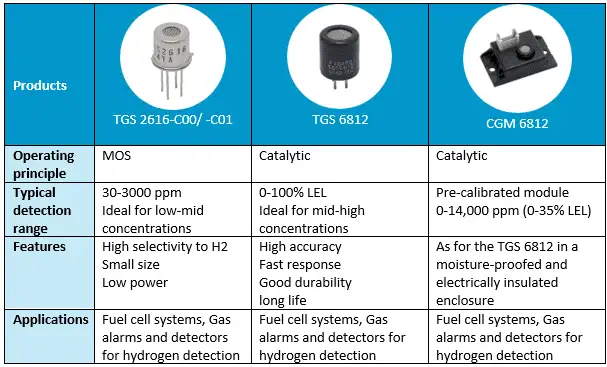
If you are looking for a hydrogen sensor with a fast startup and response time for applications such as hydrogen leak detection for FCEV please contact Omni Sensors for further information. Figaro will shortly be adding a catalytic-type hydrogen sensor comprising a detector and compensator to their portfolio. This sensor is 0-100% LEL, has ≥15 years life, requires no maintenance and is resistant to silicone poisoning.


