Many organisations collect environmental data. Fewer turn that data into better decisions.
A temperature reading, a rise in carbon dioxide or a change in differential pressure can be useful on its own. However, the real value comes from being able to see what is happening across a building, process or group of sites; identify patterns; receive an alert when conditions move outside chosen limits; and act before a small issue becomes an expensive one.
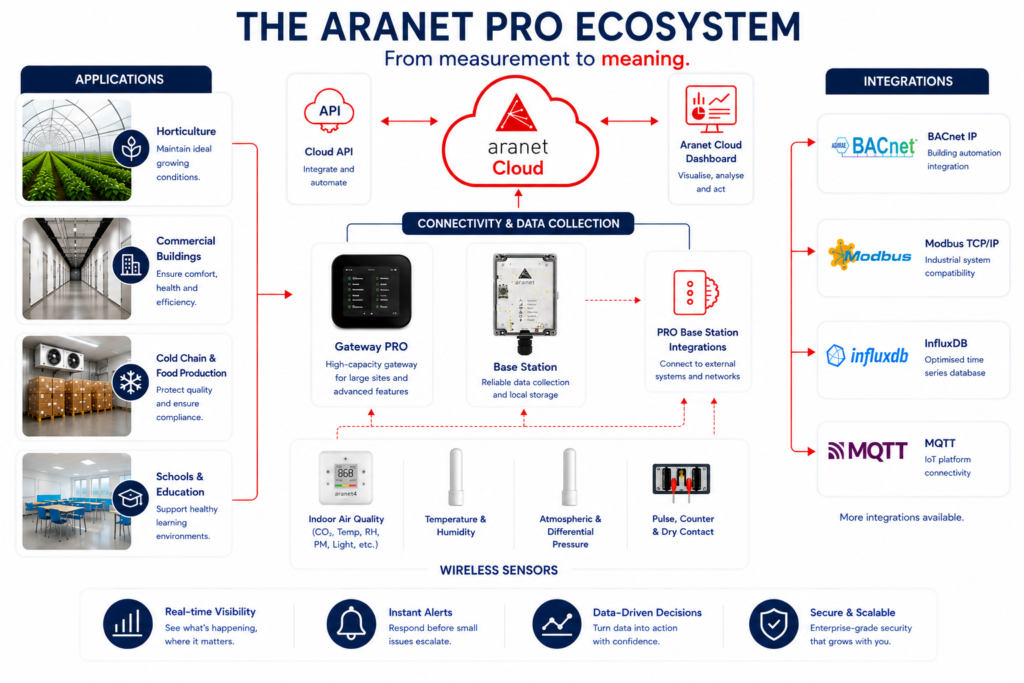
This is where the Aranet PRO ecosystem excels. It combines wireless sensors, base stations and optional cloud-based data management to create a flexible environmental monitoring system. Rather than installing a separate, isolated instrument for every measurement, users can bring information from multiple sensors and locations into one view.
The Aranet PRO ecosystem is simple to install and will provide a clearer understanding of the environment enabling decisions to be taken based on evidence rather than snapshots
What is the Aranet PRO Ecosystem?
The system has three principal elements:
- Wireless sensors measure parameters such as carbon dioxide (CO2), temperature, relative humidity, atmospheric or differential pressure, particulate matter, radon, light, energy use and equipment operating time. Aranet also offers specialist sensors for horticulture and other applications.
- An Aranet base station or gateway receives measurements from the sensors and provides a central point from which the data can be viewed. Features, management and data storage options and connectivity capabilities are device dependent.
- Aranet Cloud, where required, provides centralised remote access, dashboards, analysis, alarms and management of data from multiple base stations and sites.
The ecosystem can also accept signals from compatible third-party instruments through Aranet transmitters for 4–20 mA, 0–10 V, pulse and dry-contact outputs. This is especially useful for integrating existing specialist sensors or meters into one wireless monitoring platform.
The battery-powered wireless sensors reduce cabling and disruption, while making it easy to start small and expand as requirements grow.
Which applications are particularly well suited to Aranet PRO?
- Offices, schools and other occupied buildings
CO₂ is a useful indicator of whether ventilation is keeping pace with room occupancy. By combining CO₂, temperature, humidity and particulate measurements, those responsible for the building can see how conditions vary between rooms and throughout the working or school day.
This can help to:
- identify poorly ventilated or uncomfortable areas and adjust ventilation to match demand;
- investigate recurring complaints and assess the effects of changes in room use or occupancy; and
- demonstrate that indoor environmental conditions are being actively monitored.
The objective is not simply to display a number. It is to reveal when, where and under what circumstances conditions deteriorate, so that practical improvements can be targeted more effectively.
- HVAC performance and building energy management
Heating, cooling and ventilation are major operating costs in many buildings. Using these systems too little can compromise comfort and indoor air quality, while using them more intensively or for longer than necessary wastes energy.
Aranet sensors provide the data needed to balance comfort, air quality and energy use. They can identify hot and cold spots, assess ventilation against occupancy, monitor filters and airflow, and track equipment operation and energy consumption.
This helps to:
- optimise heating and ventilation according to demand;
- identify poor performance or unnecessary operation; and
- measure the results of HVAC adjustments and energy-saving projects.
Where a building management system is already installed, Aranet can be used as a flexible additional data layer or integrated into third-party systems, subject to the selected hardware, licences and integration method.
- Refrigerated storage, food production and the cold chain
In cold rooms, fridges, freezers, warehouses and food-processing areas, a temperature problem can lead to product loss, reduced shelf life or a compliance review. Continuous monitoring provides far more useful evidence than occasional manual checks.
Wireless temperature and humidity sensors can:
- quickly identify temperature excursions and recurring problems;
- provide a time-stamped record across different storage locations; and
- reduce manual logging.
This can support Hazard Analysis and Critical Control Point (HACCP) and quality-management procedures. However, sensor selection, placement, calibration, alarm handling and record keeping must meet the user’s regulatory and quality requirements.
- Horticulture, controlled-environment agriculture and research growing
Plant performance depends on the interaction of several variables, not one measurement in isolation. Air temperature, humidity, CO₂, light, substrate moisture, electrical conductivity, pH, drainage, plant temperature and other parameters can all influence growth, water use and yield.
An Aranet system allows growers and researchers to monitor these factors together and track changes and trends, leading to better irrigation decisions, more consistent climate control, earlier identification of plant stress and controlled comparisons between growing zones or treatments.
Better consistency, more efficient use of water and energy, and improved saleable yield can deliver valuable commercial gains. For R&D teams, simultaneous measurements simplify data collection and analysis.
- Livestock buildings and animal welfare
Temperature, humidity, CO2 and ammonia can influence animal comfort, health and productivity, as well as working conditions for staff. Conditions can also vary considerably within one building and change with stocking density, weather and ventilation settings.
By monitoring several locations continuously, farm managers can identify localised or developing problems that occasional individual readings may miss. The resulting data can support ventilation adjustments, investigation of health or performance issues and evaluation of changes to housing or operating practice.
- Laboratories, R&D, product trials and pilot plants
Research frequently requires multiple measurements to be collected at the same time and in several positions. Installing a fully wired data-acquisition system may be disproportionate for a temporary trial, while manual readings consume time and can miss short-lived events.
The Aranet system is ideally suited for:
- environmental mapping and baseline studies;
- comparison of prototypes, materials or operating settings;
- monitoring test chambers, laboratories and pilot installations;
- checking correlations between environmental conditions and product behaviour; and
- rapidly redeploying sensors as an experiment develops.
Data can be viewed and exported for further analysis, while integration options allow selected Aranet measurements to feed other applications.
- Museums, archives, storage areas and other sensitive assets
Books, artworks, historical objects, electronic equipment and stored products can be damaged by unsuitable or rapidly changing temperature and humidity. Monitoring at several points can reveal localised conditions near external walls, display cases, shelving and air outlets that a single measurement may miss.
Trend data and alerts support earlier action, provide useful records for insurers or stakeholders, and help avoid conditioning an entire space when the problem is confined to one area.
- Equipment, utilities and preventative maintenance
Not every valuable measurement is an environmental one. Through energy meters, hour meters, pulse counters, dry-contact monitoring and transmitters, Aranet can also help track equipment runtime, electricity consumption, meter pulses or an external sensor’s analogue output.
This can reveal abnormal operating patterns, support maintenance based on actual runtime, verify whether equipment was active during an incident and highlight opportunities to reduce energy or water use.
The business case: what can an organisation gain?
Lower installation and expansion costs
Wireless, battery-powered sensors can reduce cabling, drilling and disruption – particularly in occupied, rented, listed or frequently reconfigured premises. A pilot can be installed in selected problem areas before committing to wider deployment, and additional measurement points can be added as the value becomes clear.
Fewer avoidable losses
Earlier warning of a failing refrigerator, an unsuitable storage environment, poor irrigation or abnormal equipment behaviour can prevent spoilage, asset damage, lost experimental work and unplanned downtime. The avoided cost of one significant incident may exceed the cost of monitoring it.
Better use of energy and resources
Recorded data helps businesses distinguish necessary consumption from waste. It can show where heating, cooling, ventilation, lighting, irrigation or machinery operation is not aligned with demand, and provide evidence that corrective action has worked.
More productive maintenance and investigation
Engineers are more effective when they know what happened before they arrived. Historical trends can narrow the search for intermittent faults and help teams prioritise the locations and equipment that genuinely require attention.
Stronger evidence and accountability
Continuous records replace assumptions and isolated spot checks with a traceable picture of conditions over time. This can support internal quality systems, customer reporting, research documentation, sustainability initiatives and discussions between facilities teams, employees, tenants or suppliers.
Health, wellbeing and safety: an important distinction
Environmental monitoring can make a valuable contribution to healthier and safer spaces. It can highlight inadequate ventilation, uncomfortable heat or humidity, particulate pollution, radon trends or ammonia levels, enabling the responsible team to investigate and respond.
However, an environmental monitoring ecosystem should not automatically be treated as a substitute for a certified life-safety alarm, gas detection system or other legally required protective device. Suitability depends on the sensor, installation, alarm architecture, risk assessment and applicable regulations. Where failure to detect a condition could create an immediate danger, a competent safety professional should determine the required certified equipment and response procedures.
Aranet is at its strongest when used to make conditions visible, identify trends, send configurable notifications and support informed action. That can complement – but should not be assumed to replace – dedicated safety systems.
When does an ecosystem approach make most sense?
Aranet PRO is particularly attractive when an organisation:
- needs measurements from several rooms, zones, assets or sites;
- wants continuous trends rather than occasional spot readings;
- would find new cabling difficult, disruptive or expensive;
- expects its monitoring requirements to grow or change;
- wants alerts and remote access to data;
- needs to combine different environmental and operational measurements; or
- wants evidence with which to evaluate an improvement, fault or investment.
The best system does not begin with the largest possible list of sensors. It begins with a clear question: What decision do we want this measurement to improve?
Building the right Aranet solution with Omni Sensors and Transmitters
As an Aranet distributor, Omni Sensors and Transmitters can help you move from that question to a practical system. This includes identifying the parameters that matter, selecting appropriate sensors and base-station or cloud options, considering sensor positioning and planning a pilot that can be expanded if it delivers value.
Whether your priority is indoor air quality, energy efficiency, product protection, horticultural performance, research data or remote oversight of several locations, the Aranet PRO ecosystem offers a flexible route from isolated measurements to useful, actionable information.
To discuss your application or select a suitable Aranet monitoring package, contact Omni Sensors and Transmitters.