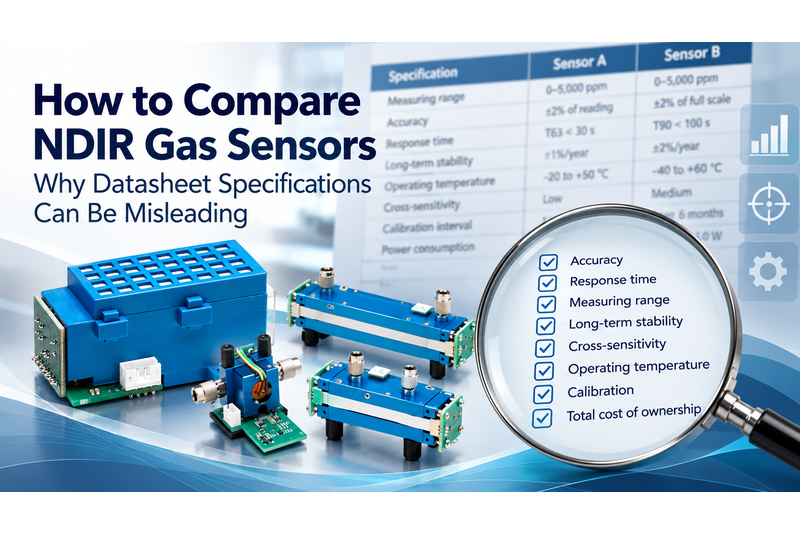
In simple terms, a gas sensor is a device capable of responding to the presence of gas defined by certain parameters.
Detecting gas is based upon the concentration of gas present in the atmosphere changing a property of the sensor’s material or circuitry. This might be resistance in the case of a semiconductor or catalytic sensor, current in the case of an electrochemical sensor or voltage from the thermopile detector within an NDIR sensor. Results are measured in units of resistance, current or voltage. The output is directly proportional to the gas concentration.
The sensor type is selected according to the application, gas species, concentration range and accuracy requirements.
If the sensor is to be used within an analyser to provide a measurement over a pre-determined concentration range, full calibration; zero and span is essential prior to deployment, also on an ongoing basis according to manufacturer recommendations.
If the sensor is to be employed within a gas leak detector or as a safety monitor it works on a threshold system, generating an alarm if a pre-set value for electric current, voltage or resistance is exceeded. This involves pre-calibration with clean air as the zero gas and calibration gas at the alarm concentration to set the threshold for the electrical current or alternative electrical measurement parameter. To ensure the correct working of this sensor bump tests should be carried out on a routine basis whereby the gas detector is subjected to a concentration of calibration gas at the lowest level at which the alarm should trip.
Gas Sensors: Where are they used?
The prevention of hazardous gas leaks, detection of toxic pollutants and process control all involve the use of gas sensors for either detection or measurement. Semiconductor and catalytic sensors are typically used for detection purposes. Electrochemical, galvanic and NDIR sensors may be used for detection but are also commonly used to provide a ppm or % vol read-out.
With an increased demand for health and safety monitoring in industry and homes, there are a wide variety of applications.
Homes require carbon monoxide (CO) detectors to check on emissions from gas-fired boilers, domestic coal/log fires and wood burners.
CO detectors are also used for ventilation control of indoor parking garages and fire detection in both domestic and industrial environments such as biomass milling operations and storage silos.
LPG and Natural gas leak detectors are used for gas appliances.
Leak detection of refrigerants from air conditioners and refrigeration systems in a variety of settings cold stores, supermarkets, commercial, industrial and transportation
VOC air contaminants are detected through the use of VOC, Air Quality monitors and odour monitors which are frequently integrated with an air cleaning or ventilation control system. Airlines, restaurants and hotels are potential customers for these detectors.
Breathalysers contain a sensor which will alarm if exhaled breath exceeds the legal limit of alcohol for driving. Detectors employing the same sensor are used to monitor solvent levels in dry cleaner facilities, the semi-conductor industry and other industries using solvents within their manufacturing processes.
Carbon dioxide monitors (CO2) are used in many commercial and residential HVAC systems. They can also be used to monitor ventilation levels within schools and other public indoor environments to enable corrective action to be taken. This is particularly important for the reduction of virus transmission.
Oxygen sensors are used for a diverse range of applications which include: within the biotechnology industry both oxygen incubators and anaerobic work stations, medical ventilation equipment, in food packaging, greenhouses, fire detectors, combustion monitoring in fuel cell systems, flue gas emission monitoring and air monitoring for oxygen deficiency which is necessary for workers in enclosed or confined spaces – storage areas, pipes, sewers and tunnels due to the lack of ventilation, also breweries and labs where other gases are used and there is a potential oxygen depletion risk.
Ammonia, NH3 detectors are used to prevent excess build-up of this toxic gas in livestock and poultry farms as well as sewage treatment plants and NDIR sensors are used to monitor levels of pest control fumigants in containers, also SF6 levels from insulated switchgear or transformers amongst other applications.
Ethene and CO2 can be monitored to control fruit storage and ripening and methane in combination with CO2 measurement is used to monitor and control the biogas fermentation process, these are two examples of how gas sensors can be used in process control.
Environmental pollution is another increasingly needed aspect of gas sensor monitoring and the likes of O2, CO, SO2, NO. NO2, CO2, H2S and HC sensors are used to measure emissions from Industrial processes and incineration as well as from vehicles.
Gas Sensors: Types of Gas Sensors
There are many types of gas sensors that are categorised according to the type of sensing element used: semiconductor-based gas sensors, electrochemical, catalytic, optical sensors, photoacoustic, photo ionisation, thermal conductivity and colorimetric to name a few.
The performance of different types of gas sensors is based upon their sensitivity, selectivity and detection limit along with their response and recovery time.
A few of the most commonly used sensors are summarised below together with their advantages and disadvantages.

Semiconductor Gas Sensor
Originating in Japan, these sensors were first used as gas leak alarms. Reducing gases react on the heated semiconductor surface with oxygen and water vapour resulting in a decrease in resistance, conversely, oxidising gases will cause the resistance to increase.
The change in resistance is logarithmically proportional to the concentration. MOS (metal oxide semiconductor) sensors are mechanically robust and have a long life expectancy. They are relatively low cost and sensitive. Their main disadvantages are cross-sensitivity and poor selectivity to some gases, but they can be “tuned” to determine the concentration of specific constituents by using different sensing materials and multi-sensor arrays. The baseline (zero ) will shift over time so regular calibration with the target gas is advised. (bump testing)
Catalytic/ Pellistor bead Gas Sensor
The catalytic bead sensor is comprised of two coils of fine platinum wire each embedded in a bead of alumina, one of the beads is impregnated with a special catalyst to promote oxidation and the other is treated to inhibit oxidation. The two beads/ pellistors are connected electrically in a Wheatstone bridge circuit. Combustible gas will oxidise on the “catalytic” bead causing a rise in temperature and resistance but no reaction will occur on the “inert” bead, this results in an imbalance in the circuit and voltage output proportional to the concentration of the combustible gas.
These sensors are accurate, reproducible, minimally affected by temperature and humidity but they do
need a minimum level of oxygen in order to work and are easily desensitised ( poisoned )by materials containing lead, silicon and chlorine so regular bump testing is advisable.
Electrochemical Gas Sensor
There are essentially three types of electrochemical sensor: Galvanic, voltaic, and electrolytic.
Galvanic and voltaic sensors feature spontaneous cell reactions and convert chemical to electrical energy. Electrolytic sensors work in reverse, using electrical energy to electrolyse certain gases.
Electrochemical cells have high sensitivity, good selectivity, require no or low power depending on the type, have a fast response and a direct linear output to concentration.
Downsides include their short lifetime and bulky size relative to say a semiconductor sensor, positional dependency if a solid-state electrolyte isn’t employed and limited operating temperature.
Non-diffuse infrared, NDIR Gas Sensors
These sensors are comprised of 4 components: the NIR light source, the sample chamber, NIR optical filters and the detector. IR light passes through the sample chamber containing the target gas in addition to other gases present, then through a measurement and reference filter just prior to the detector. The measurement filter eliminates all light apart from the energy (wavelength band) which the target gas absorbs. The reference filter is chosen to be close in wavelength to the measurement filter but is non absorbing for any gas species. The resultant detector signals are ratioed to provide an output directly proportional to the concentration of the target gas.
Although use of these sensors are limited to polar gases, they have a fast response time, good sensitivity, are selective or can be desensitised to interferants through the use of multichannel sensors and can be used in inert atmospheres. They do require a minimum warm-up time and are a little more costly than catalytic sensors which might be used as an alternative.
For a thorough overview of the gas sensors supplied by Omni Sensors and Transmitters please take a look at our Gas Sensor Page or use our online enquiry form to get in touch.