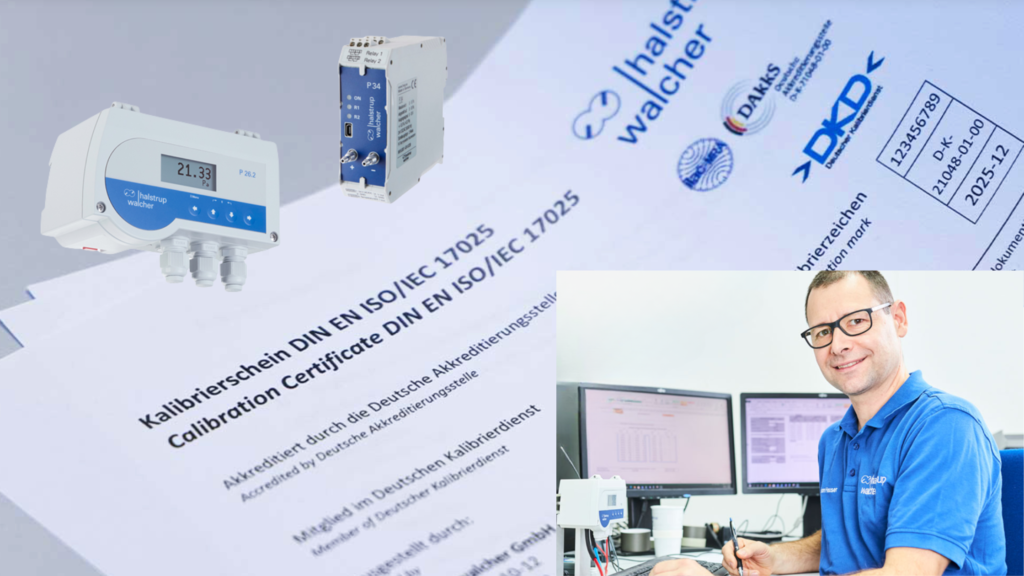
Differential pressure transmitters provide accurate differential pressure measurements in applications ranging from HVAC systems and cleanrooms to industrial processes and combustion equipment.
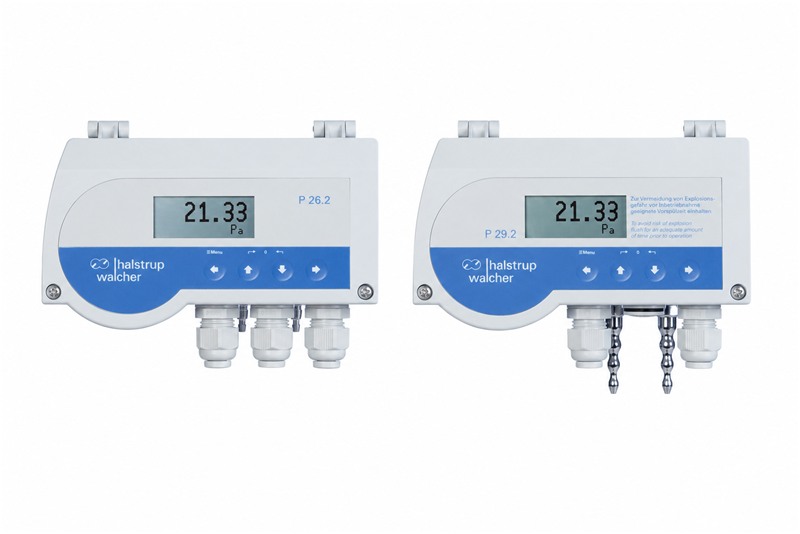
The new Halstrup Walcher P26.2 differential pressure transmitter and Halstrup Walcher P29.2 differential pressure transmitter build on the established P26 and P29 ranges. They retain proven measurement features while introducing improvements intended to simplify installation, configuration and integration.
What has changed, and which model is suited to each application?

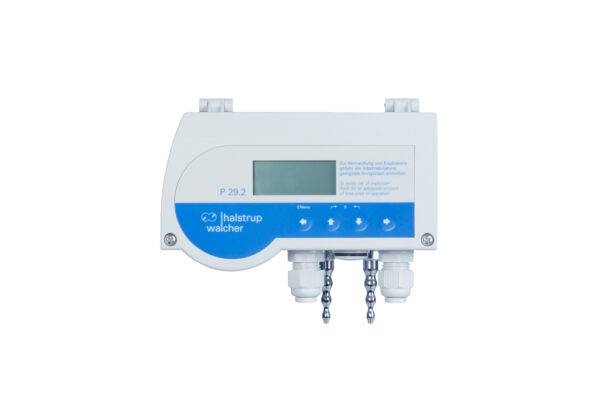
P26.2 for HVAC, cleanrooms and airflow measurement
The P26.2 is designed to measure differential pressure in air and non-aggressive gases. With measuring ranges starting at 10 Pa, it is particularly suited to applications where small pressure differences must be measured accurately.
Typical P26.2 applications include:
- HVAC and ventilation systems
- Cleanroom pressure monitoring
- Laboratories and pharmaceutical facilities
- Operating theatres and healthcare environments
- Filter monitoring
- Airflow and volume-flow measurement
- Industrial and process ventilation
- Energy and air-consumption monitoring
Like the previous P26 transmitter, the P26.2 offers automatic zero-point adjustment, scalable measuring ranges and accuracy options down to ±0.2% of full scale. The new generation adds several features intended to make integration and commissioning easier. Full specifications and configuration options are available in the manufacturer’s P26.2 technical information.
USB-C configuration simplifies commissioning
An internal USB-C interface is supplied as standard. Using Halstrup Walcher’s free parameterisation software, engineers can connect the transmitter to a PC for configuration and commissioning. Configurations can also be saved and transferred to other transmitters.
This is useful for HVAC OEMs, machine builders and system integrators producing multiple identical machines, air-handling units or ventilation systems. A defined configuration can be created once and reused across several devices, potentially reducing commissioning time.
Optional M12 connection supports faster installation
The P26.2 can be specified with preconfigured M12 electrical connections as an alternative to conventional cable glands. For OEMs and machine builders, M12 connectivity can simplify wiring and make transmitter replacement easier during servicing or maintenance.
Two switching outputs as standard
The P26.2 incorporates two potential-free semiconductor switching outputs as standard. These outputs support additional monitoring or control functions without necessarily requiring separate switching components. A differential pressure or airflow threshold could, for example, generate an alarm or signal another part of the control system.
Improved airflow and volume-flow measurement
Differential pressure transmitters are commonly used with suitable primary measurement elements to calculate airflow. Changes in air temperature and atmospheric pressure affect air density, which can influence the calculated volume flow.
The P26.2 can be specified with temperature compensation or pressure-and-temperature compensation for volume-flow measurement. This is relevant where the objective is not simply to measure differential pressure, but to obtain a more accurate indication of airflow, volume flow or air consumption under changing environmental conditions.
Potential applications include:
- Air-handling units
- HVAC airflow monitoring
- Building ventilation systems
- Process airflow measurement
- Industrial ventilation
- Air-consumption monitoring
- Building and industrial energy-management systems
P29.2 for natural gas and combustion applications
While the P26.2 addresses a broad range of air and non-aggressive gas applications, the P29.2 has a more specialised role. It is designed for differential pressure measurement involving natural gases such as methane and butane, making it relevant to industrial combustion and process applications.
Typical P29.2 applications include:
- Industrial burners
- Industrial furnaces
- Boilers and combustion systems
- Ovens and kilns
- Gas trains
- Natural-gas flow measurement
- Process heating equipment
Differential pressure measurements within these systems can be used to derive volume flow, mass flow and flow velocity. The P29.2 also incorporates USB-C configuration, two semiconductor switching outputs as standard and optional M12 connectivity. It can operate from a 24 VAC or DC supply, providing additional installation flexibility. See the manufacturer’s P29.2 technical information for the available measuring ranges, outputs and options.
Important: the P29.2 is intended for natural gas applications without Ex-zone requirements. Its construction separates potential ignition sources from the gas mixture, but it is not a differential pressure transmitter for installation within hazardous Ex areas. Application suitability must be assessed against the system design and applicable safety requirements.
P26 vs P26.2 and P29 vs P29.2: what has changed?
The move from the P26 and P29 to the P26.2 and P29.2 is an evolution of an established differential pressure measurement platform rather than a complete redesign. Important characteristics, including high measurement accuracy, automatic zero-point correction, scalable measuring ranges and IP65 protection, remain.
Key improvements include:
- USB-C configuration
- Reusable transmitter configurations
- Optional M12 electrical connectivity
- Two semiconductor switching outputs as standard
- Simplified installation and commissioning
- Enhanced compensated volume-flow measurement on the P26.2
For engineers, the practical benefit is reduced engineering and commissioning effort when integrating pressure and airflow measurement into a wider control system.
Which Halstrup Walcher differential pressure transmitter should you choose?
For HVAC systems, cleanrooms, laboratories, pharmaceutical facilities, filter monitoring, airflow measurement and general air or non-aggressive gas applications, the P26.2 provides the broader solution, with measuring ranges starting from 10 Pa.
For natural-gas, industrial burner, furnace and combustion applications without Ex-zone requirements, the P29.2 is designed around those specific gas measurement needs.
Both models show how modern differential pressure measurement is moving beyond a simple pressure signal towards transmitters that are easier to configure, commission and integrate into complete monitoring and control systems.
Looking for a differential pressure transmitter for your application?
Omni Sensors & Transmitters supplies Halstrup Walcher pressure measurement products in the UK. Whether you are designing an HVAC, cleanroom, airflow measurement, industrial process or combustion system, or currently use an earlier P26 or P29 transmitter, contact Omni Sensors & Transmitters to discuss the most appropriate differential pressure measurement solution for your application.