Pressure transmitters and manometers play a vital role in maintaining the safe and efficient operation of countless industrial and commercial processes. From controlling airflow in cleanrooms and operating theatres to monitoring ventilation systems, production equipment and process pressures, accurate pressure measurement is fundamental to quality, safety and regulatory compliance.
Yet even the highest quality pressure measurement instruments will gradually drift from their original specification over time.
Regular calibration provides confidence that your instruments continue to perform as expected, helping to avoid costly process errors, maintain product quality and satisfy the requirements of quality management systems.
What is Pressure Calibration?
Pressure calibration is the process of comparing the readings from a pressure measuring instrument with a certified reference standard whose accuracy is known and traceable to national standards.
The comparison identifies any deviation between the instrument and the reference. Where necessary, the instrument can then be adjusted to restore its original performance before being returned to service with documented evidence of its accuracy.
Calibration provides users with confidence that the measurements they rely upon every day remain trustworthy.
Why Do Pressure Instruments Drift?
All pressure measuring devices change slightly over time.
Factors such as mechanical stress, vibration, pressure cycling, ageing of sensing elements, temperature changes and long-term electronic drift can all influence measurement accuracy.
In many applications these changes may be relatively small, but where pressure is used to control critical environments, even minor deviations can become significant.
Examples include:
- Maintaining positive pressure within pharmaceutical cleanrooms
- Verifying airflow within HVAC systems
- Monitoring differential pressure across filters
- Process control within manufacturing facilities
- Laboratory and research applications
- Critical healthcare environments
Routine calibration allows these changes to be identified before they begin affecting product quality, energy efficiency or regulatory compliance.
When Should Pressure Transmitters Be Recalibrated?
There is no single calibration interval that suits every application.
The appropriate schedule depends upon several factors, including:
- The criticality of the measurement
- Environmental conditions
- Frequency of use
- Previous calibration history
- Internal quality procedures
- Customer or regulatory requirements
Many companies adopt annual calibration as part of their preventative maintenance programme, while others determine calibration intervals using historical stability data and risk assessments.
Establishing a regular calibration programme reduces uncertainty and provides documented evidence that pressure measurements remain within specification.
DAkkS or UKAS – Are They Equivalent?
One question frequently asked by UK customers is whether calibration certificates issued in Germany carry the same recognition as those issued in the United Kingdom.
The answer is yes.
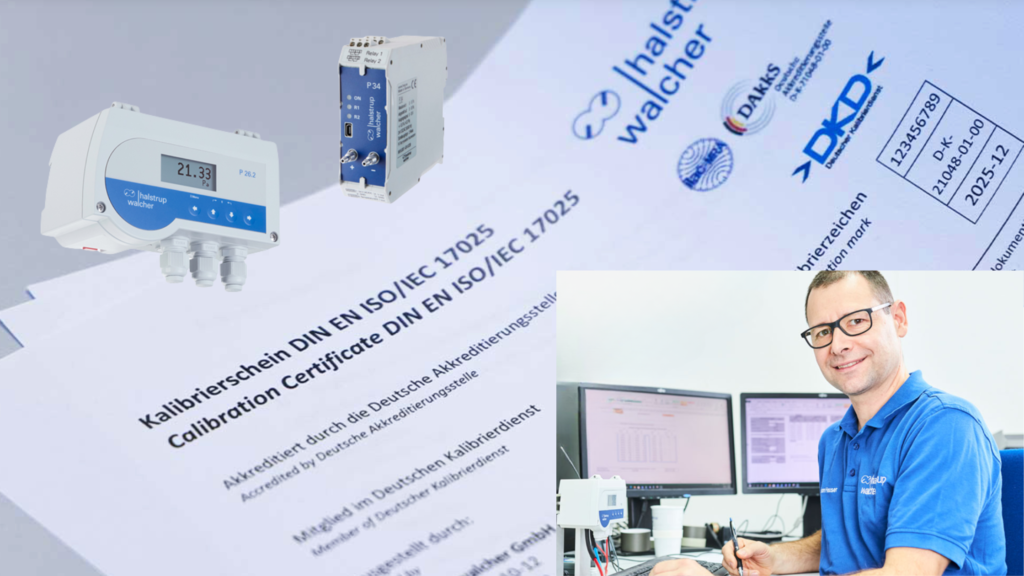
Halstrup-Walcher has been a member of the German Calibration Service (DKD) since 1999 and, since 2010, its calibration laboratory has been accredited by Germany’s national accreditation body, DAkkS, under accreditation number D-K-21048-01-00. DAkkS-accredited calibration certificates issued to ISO/IEC 17025 are internationally recognised through the ILAC Mutual Recognition Arrangement, providing the same international technical recognition as UKAS-accredited ISO/IEC 17025 calibration certificates.
For customers operating internationally, this provides assurance that calibration results are fully traceable and internationally accepted.
Accredited Calibration or Factory Calibration?
Not every application requires the same level of calibration.
Halstrup-Walcher offers both accredited calibration and factory calibration, allowing customers to select the service that best matches their application.
ISO/IEC 17025 Accredited Calibration
Calibration performed according to recognised DKD pressure calibration procedures provides:
- Complete traceability to national standards
- Documented measurement uncertainty
- Consideration of environmental influences
- Internationally recognised calibration certificates
- Confidence for quality-critical applications
These calibrations are particularly suited to measurement devices whose accuracy directly influences product quality, regulatory compliance or process safety.
Factory Calibration
For many development, maintenance and general industrial applications, factory calibration offers a great alternative.
Factory calibrations are performed using traceable reference instruments and documented in accordance with ISO 9001 procedures. While they do not include a statement of measurement uncertainty, they provide a cost effective solution where accredited calibration is not required.
Why Choose Halstrup-Walcher for Calibration?
Choosing the original manufacturer to calibrate your instruments offers several important advantages.
Halstrup-Walcher’s accredited laboratory combines decades of pressure measurement expertise with specialist reference equipment and manufacturer-specific knowledge to ensure instruments continue to perform as originally specified.
Customers benefit from:
- DAkkS-accredited ISO/IEC 17025 calibration
- Highly accurate reference standards
- Complete measurement traceability
- Manufacturer expertise
- Comprehensive calibration documentation
- Rapid turnaround
- Adjustment services where required
An additional advantage is that Halstrup-Walcher calibrates instruments from all manufacturers – not just its own products. This makes the service an attractive option for those using a variety of pressure instrumentation devices.
What Can Be Calibrated?
The laboratory offers calibration services for a wide range of pressure measurement equipment, including:
- Differential pressure transmitters
- Absolute pressure transmitters
- Portable manometers
- Pressure calibration devices
Calibration covers:
- Absolute pressures from 0.25 bar to 20 bar
- Negative and positive gauge pressures from -75 mbar to 20 bar
using air or nitrogen as the calibration medium. Calibration certificates can be supplied either as DAkkS-accredited certificates according to recognised DKD procedures or as factory calibration documentation, depending on customer requirements.
More Than Calibration
Calibration identifies whether an instrument remains within specification.
If a Halstrup-Walcher instrument is found to have drifted beyond acceptable limits, the service doesn’t stop there.
Following consultation with the customer, Halstrup-Walcher can adjust the instrument to restore its performance before carrying out a further calibration to confirm the corrected accuracy. This additional service helps maximise instrument life while ensuring the required measurement performance is maintained. The company also offers repair services and reconfiguration of KAL series pressure calibrators, helping customers protect their investment and minimise equipment downtime.
Calibration Support for UK Customers
For UK customers, Omni Sensors & Transmitters is the long-standing local distributor for Halstrup-Walcher and your first point of contact for calibration requirements. We can provide quotations, help identify the most appropriate calibration service and coordinate the return and shipping of instruments to Halstrup-Walcher, making the process as straightforward as possible. Speak to a member of the team today.