
Gas Sensors, CO2 Monitors, Temperature Sensors, Air Velocity Transmitters and more.
We have been helping customers; manufacturers, suppliers, and end users for over 15 years across many industries select the right sensor or transmitter solution for their application
Can’t find what you’re looking for, or need any other help? If you have any questions you can always contact our experienced support team which are available to reply asap.

Our range
We supply a diverse range of excellent gas sensing solutions.
Our products include a wide choice of sensing elements and sensor modules with analogue or digital outputs. We stock probes and transmitters suitable for OEMs, suppliers, installers and end-users.
Many of our gas sensors are Figaro sensors. These are used by OEMs of portable and static gas leak detection devices and indoor air quality monitoring sensors. They are also popular with manufacturers of gas analysis equipment requiring a ppm or % reading.
Why choose Omni Sensors and Transmitter’s range of gas sensors?
Selecting the right gas sensor will depend on factors such as sensitivity, selectivity, power consumption, response time and cost. In many cases, gas sensing technologies can be combined.
Our extensive range of gas sensors includes:
Electrochemical Sensors
Electrochemical sensors measure the concentration of a target gas by oxidising or reducing the target gas at an electrode and measuring the resulting current.
- Oxygen and lead-free oxygen sensors are typically used to provide an actual concentration reading within incubators, safety cabinets, workstations, MAP (modified atmosphere packaging), and work locations where there’s a possibility of oxygen enrichment or depletion.
- Carbon monoxide sensors detect any CO build-up in enclosed parking garages, residences, or private garages. They will provide an alarm if a critical level is exceeded.
- Ammonia gas sensors are used in ventilation control of poultry and livestock sheds and for leak detection when used as a refrigerant.
- NO2 sensors and nitric oxide sensors are frequently used for ventilation control of indoor parking garages.
- Other electrochemical sensors detect toxic gas leaks of hydrogen sulphide, chlorine, and sulphur dioxide.
Metal Oxide Semiconductor Sensors
Metal oxide semiconductor gas sensors are relatively low-cost compared to other sensing technologies. They are robust, lightweight, long-lasting and benefit from high material sensitivity and quick response times.
We Offer:
- VOC sensors for indoor air quality detection.
- Acetone sensors for breath testing medical devices.
- Hydrogen sensors for leak detection from fuel cells, gas appliances, and transformers.
- Methane and carbon monoxide sensors for home air quality monitors.
- Refrigerant sensors for leak detection from air conditioning and refrigeration systems.
- LP gas sensors for residential gas leak detection.
- Methane sensors to detect the presence of leaks from gas appliances, natural gas vehicles, and pipelines.
Catalytic sensors
These can measure higher concentrations as well as lower concentrations for flammable gases, up to 100% LEL compared with 25% LEL maximum from most metal oxide semiconductor sensors for hydrogen, methane, and LP gas.
NDIR Sensors / CO2 Sensors
An NDIR (nondispersive infrared sensor) is a simple spectroscopic sensor often used as a gas detector.
- Compact low-powered NDIR CO2 sensors with UART and/or I2C interface are offered through Figaro and E+E Elektronik to enable control of air conditioners, fans, and window openers to control building ventilation.
- High-accuracy NDIR modules can be found within our SmartGAS diffusion and flow modules range.
- Refrigerant gas sensors, biogas sensors, nitrous oxide sensors, and SF6 sensors are part of our diffusion range which maintains a safe environment and reduces emission of greenhouse gases
- Ethylene sensors, sulphur dioxide and nitrous oxide sensors are flow-through designs for process measurement. This range excludes refrigerants.
- Own-label transmitters can be supplied for the diffusion range.
- CO2 probes and CO2 monitors are also offered.
- Silarex is a multichannel NDIR flow module for optimal accuracy when measuring multiple gases that have cross interference in the NDIR or different ranges of a single gas as with CO2 in TOC analysis.
- PAS sensor is for high precision monitoring at extremely low concentrations.
We supply a diverse range of humidity and dew point measurement solutions.
Our products include digital and capacitive sensing elements.
We have a wide range of humidity sensors, humidity probes and monitors with different humidity and temperature ranges, analogue or digital outputs and wireless communications.
We also offer dew point transmitters and dew point meters to OEMs, suppliers, installers and end-users.
Most of our humidity and dew point transmitters are manufactured by E+E Elektronik, who have been developing and producing humidity elements with thin-film technology for over 30 years.
E+E Elektronik is a nationally accredited calibration laboratory. Their reliable, high-precision relative humidity sensors and dew point measurement instruments are the combined result of continued investment in future developments, state-of-the-art production technology, and calibration expertise.
Aranet manufactures the remainder of our humidity and dew point sensors. They provide a wireless range for applications requiring wireless monitoring.
Wireless solutions are popular with museums and art galleries where cabling is intrusive and might damage the structure of historic buildings. They are also an excellent solution for horticultural glass houses, which are difficult to wire and monitor due to their construction and size.
- Our E+E capacitive humidity sensing elements, the HC and HMC series, feature excellent linearity, sensitivity, long-term stability, and sensor-to-sensor reproducibility of sensor characteristics.
- The digital sensors: THE 501 and EEH210 are accurate and robust due to the proprietary E+E sensor coating and offer a variety of interfaces for easy design-in. Many large electronics companies are using E+E humidity sensors in their products.
Why choose Omni Sensors and Transmitter’s range of humidity sensors, humidity gauges and dew point temperature sensors?
Our sensors are perfect for a multitude of applications with different challenges such as high humidity condensing environments, polluting atmospheres, wireless installation and a requirement for 100% up-time.
Our sensors implement many different strategies, including:
- continuous heating of the sensor element
- dual heating system for the element and probe
- a proprietary protective sensor element coating
- Automatic Sensor Recovery mode
- Aranet wireless CO2 sensors and monitors
- E+E interchangeable sensing modules to minimise down-time
Who should use Omni Sensors and Transmitter’s range of humidity sensors, humidity gauges and dew point temperature sensors?
Our humidity measuring products are vital across many industries and sectors where they can monitor and control humidity.
- HVAC
- BAS
- Humidifiers
- Storage and cooling
- Ripening rooms
- Meteorology
- Climate and test chambers
- Cleanrooms
- Greenhouses
- Mushroom farms
- Poultry incubators and hatchers
- Food and pharmaceutical manufacturing processes
- Industrial dryers
Dew point measurement is essential for many processes and purposes.
- Refrigeration and industrial dryers
- Applications involving compressed air
- Moisture-sensitive applications such as plastic moulding, semiconductor and battery production
- Safety such as the stability and insulation properties of SF6 and an electrical insulator in transformer and switchgear
We offer a wide range of moisture in oil measurement products, including:
- Compact transmitters
- Probes
- Sensors
- Handheld moisture in oil meters
for in-line and at-line measurement of water activity aw, temperature, and water content ppm. These sensors can be employed in conditions of up to 20 bar and 180 °C for oil analysis and are available with analogue or digital outputs and a local display.
The oil moisture testers are manufactured by E+E Elektronik, who have been developing and producing humidity elements for over 30 years.
They employ the same reliable, high-performance thin-film capacitive technology as used in their high-precision relative humidity sensors and dew point measurement instruments.
E+E Electroniks products measure the water content of oil as water activity and ppm concentration up to saturation point if the solubility parameters of the specific oil are known.
Why measure moisture in oil?
Moisture in oil is one of several parameters checked when testing oil, as it impacts both safety and performance:
- Excessive moisture in mineral transformer oil will reduce the oil’s insulation properties, which could lead to breakdowns and potential explosions.
- Water contamination reduces the performance of lubrication oil, leading to a risk of corrosion, overheating and malfunction of engines, hydraulic machinery, power generators, compressors, pumps and gearboxes and transmissions.
- Too much water in quenching oil used in the rapid cooling of forged or moulded metals can cause cracking within the metal and explosions due to flash vaporisation of water.
Moisture Meters
We supply a wide range of moisture sensors that use capacitive sensing technology to measure relative humidity, equilibrium moisture content, water activity and % moisture content in air and materials online, at-line, in the laboratory and in the field as portable devices.
The Schaller Messtechnik Range of Humimeters all come with data logging and the option to analyse and export data. Sensors are grouped according to application.
Paper Moisture Meters
A paper moisture meter can prevent costly damages from paper expansion or shrinking. Our meters are available for online, at-line and laboratory use.
- The MF-P-HTD is customisable, measures up to 20% moisture on 80-500 gsm papers, and communicates via Modbus.
- The PM5 portable paper moisture meter measures the absolute moisture of paper, cardboard on warm, running paper rolls and stationary cool rolls.
- The PMZ measures moisture in the interior of a stack of pulp sheets up to 40% MC, the RH5 measures relative humidity within a paper stack, and the PMSA measures the moisture content of individual sheets of paper.
Wood Moisture Meters
Monitoring the moisture content in wood is essential because moisture can cause problems as the wood undergoes processing, for example; dimensional changes in sawn wood, blown MDF and PB in the board-making press section and ill-formed fuel pellets resulting in lower combustion efficiency.
- Online HGT, BLC, BRC and BLO wood moisture transmitters.
These differ in the specification according to moisture content of wood and particle size.
They are typically installed in the base of a screw conveyor, in the inclined wall of a feed chute and in storage bunkers.
The product must cover the measurement plates and be present to a depth of 200mm or greater.
- Off-line wood moisture meters, the BMA-2 and the BMC.They measure a large sample of 12 or 12.5 litres within a sample chamber in just 30 seconds.
- Portable wood moisture testerswith a 1m insertion probe or ram-in electrodes these enable moisture measurement within a pile of wood chips and round timber or split logs, respectively.
Moisture Level in Foods
Many foods especially whole grains and beans, may be stored for some time before packaging or further processing. The moisture level is critical as high levels will cause spoilage.
We supply a range of portable and static grain moisture meters for farmers, traders, animal feed and food industries. We also offer an automatic online whole grain moisture measuring system.
Our provision for food analysis doesn’t stop at grain moisture testers. Still, it extends to the FSG, which enables non-destructive moisture testing of many food products, including finished products such as pasta spirals.
At the other end of the food production chain, we have the FL2 and FLS bale moisture meters which measure the moisture deep within a bale or haystack using a probe attachment.
The humimeter is also ideal for use on building materials and to test for moisture in leather, textiles, plastics, sludge, granulates and powders, as well as for monitoring indoor and outdoor climates.
We supply a variety of differential pressure sensors and absolute pressure transmitters, which can be mounted on a wall, in a wall panel, within a control cabinet, and additionally a couple of portable gauges.
Differential pressure sensors are installed at multiple locations within heating, ventilation, and air conditioning systems to ensure efficient and economical operation. They are also used in clean rooms for manufacturing and medical facilities
Most sensors have analogue outputs, while others have an additional USB interface and optional Profibus DP and RS232 comms or Modbus RTU/ BACnet MS/TP for alarm conditions.
One of our differential pressure sensors is wireless and communicates to an Aranet base station.
Specific models offer a display and/or volume flow measurement.
Why choose Omni Sensors and Transmitter’s range of Pressure Sensors?
We sell to OEMs, suppliers, installers of HVAC systems and clean rooms, and the medical and pharmaceutical markets.
Most of our pressure sensors are manufactured by Halstrup Walcher, who has been developing, manufacturing, and selling customer-specific solutions for differential pressure measurement since the 1950s.
The Halstrup differential pressure transmitters use inductive displacement transmitters to measure the deflection of a beryllium bronze membrane. The patented dual throttle system sends a differential signal linearised by the electronics.
This excellent design ensures excellent long-term stability and absolute zero-point stability and is perfect for positive and negative differential pressures as well as the smallest of measurement ranges.
The E+E Elektronik sensors we provide are the EE 600 and EE610 differential pressure sensors for HVAC and clean room applications.
Our Aranet sensor offers a wireless differential pressure solution.
We provide a wide variety of temperature sensors available as active or passive.
Active temperature sensors convert the resistance into an active, linearised electrical temperature output. In contrast, passive temperature sensors do not require a power supply as they simply convert the resistance to temperature based upon the sensing element specification.
As temperature influences many measurements, air or fluid temperature sensors are integral to other measurement devices.
Humidity sensors, dew point sensors, mass flow meters and moisture in oil testers use a temperature measurement to compensate or standardise the measurand. It is displayed and has an independent output.
The temperature sensing element comprises a conductive material that changes its electrical resistance as a function of temperature.
Why choose Omni Sensors and Transmitter’s range of Temperature Sensors?
E+E Elektronik humidity and temperature sensors employ a thin film resistance temperature detector called an RTD. Examples of RTD are the well-known Pt100 temperature sensor and Pt1000, made from platinum.
E+E Elektronik and Aranet’s catalogue includes:
- Wall mount
- Duct mount
- Strap-on sensors for pipes
- Portable temperature measurement devices
- Cable temperature sensors
- Digital temperature sensing elements
- Probes for remote temperature sensing
- Wireless sensors for easy installation of a temperature monitoring system
Temperature sensors are designed for specific markets: HVAC, clean rooms and microclimates, pharmaceutical, food and industrial. Selection will depend upon temperature range, the sensing element employed, their construction, IP rating and outputs.
We provide a range of wireless transmitters and receivers.
The value of a wireless monitoring system or monitoring and control system versus a wired one is significant when installation costs and upheaval, potential damage to protected buildings, aesthetics and accessibility of data are considered.
Wireless humidity and Wi-Fi temperature sensors are the perfect solution for monitoring the climate within modern and historic museums and art galleries but equally for monitoring indoor growing environments such as glasshouses for tomatoes and cucumbers, vertical farms and mushroom farms.
In addition to gas and humidity sensing, wireless temperature sensing is also used in poultry hatcheries, sheds and livestock barns where carbon dioxide and/or ammonia levels are critical to the hatching process and growth and wellbeing of poultry, cattle and pigs.
Other wireless sensor applications include indoor air quality monitoring for health and energy-saving reasons.
Why choose Omni Sensors and Transmitter’s range of wireless sensors?
We offer an excellent selection of wireless options for:
- Temperature
- RH%
- CO2
- Pressure and air velocity
- Specific sensors for agricultural, horticultural and other markets, including ammonia, plant weight, PAR and LUX sensors.
These wireless transmitters are used with a base station (dedicated router) to create a wireless monitoring solution across many devices installed indoors or outdoors.
Voltage and current sensors enable third-party sensors with analogue outputs to be part of the wireless system.
We support two wireless network systems: E+E Elektronik and Aranet. Both are quite different in design, variety, number and performance of sensors, communications range, data management software, accessibility from the cloud and integration with control systems.
Please contact Omni Sensors and Transmitters to discuss your application so we can recommend the optimum solution.
We supply a range of air velocity sensors and air mass flow sensors.
They can be handheld, portable or fixed.
The air velocity meter and the mass flow sensors work on the thermal anemometer measuring principle and use E+ E Elektronik’s state-of-the-art thin film sensor technology.
Why choose Omni Sensors and Transmitter’s range of air velocity and mass flow sensors?
Our air velocity sensor range is designed for use in HVAC, clean rooms, cabinets, medical applications and industry.
It is essential to consider the air flow rate, installation location, pressure and hygiene requirements. The mass sensors are available as insertion air flow meters or in-line flow meters for different diameters of pipe
All our air velocity and mass flow sensors are manufactured using E+E sensing elements.
Due to their design and negligible mass, the E+E sensing elements stand out for their fast response time, resistance to polluting and corrosive agents and high sensitivity even at very low air speeds typical for clean rooms and laminar flow control.
E+E Elektronik is a leading developer and manufacturer of sensors and transmitters for air flow measurement, relative humidity, temperature, dew point, moisture in oil and CO2. It is also a nationally accredited calibration laboratory.


Latest news
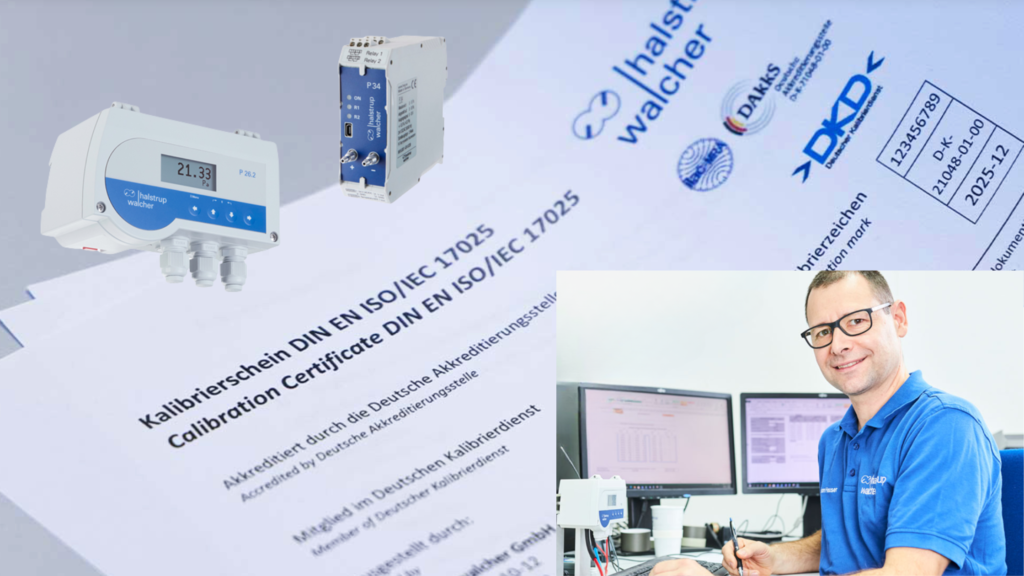
Why Pressure Calibration Matters – A Guide to Maintaining Accuracy, Compliance and Confidence
Pressure transmitters and manometers play a vital role in maintaining the safe and efficient operation of countless industrial and commercial…

From Measurement to Meaning: Where Can the Aranet PRO Ecosystem Add Value?
Many organisations collect environmental data. Fewer turn that data into better decisions. A temperature reading, a rise in carbon dioxide…

Huminode IoT Moisture and Humidity Monitoring System – Continuous Real Time Environmental and Material Monitoring
Protecting Materials, Assets and Processes Through Continuous Monitoring Moisture is one of the most common yet underestimated causes of material…